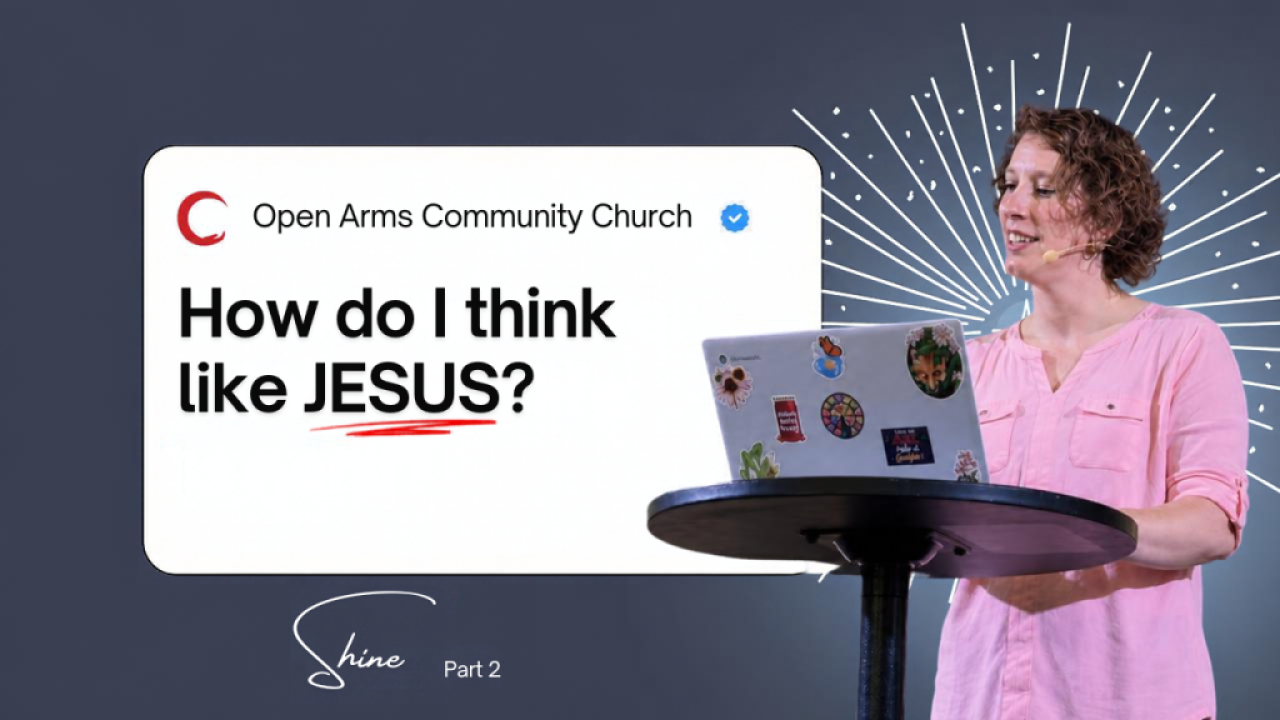
How Do I Think Like Jesus? Developing the Mind of Christ
On October 4, 2026, Melissa Robinson continued our SHINE series through Philippians at Open Arms Community Church in Bradford, PA, with a message called “The Mind of Christ.” Exploring Philippians 2:1–13, she invited us to consider how following Jesus changes our attitudes, relationships, and response to suffering. How do we think like Jesus? We begin by allowing His humility, love, and willingness to serve to shape the way we live.
Watch the message: SHINE Part 2 — The Mind of Christ
Joy That Grows Within Us
It is easy to connect joy with circumstances. When our relationships are healthy, our bills are paid, and life feels manageable, joy seems within reach. When those things fall apart, we can wonder whether joy is possible at all.
Throughout Philippians, Paul points toward a joy rooted in God’s love and His continuing work within us. That kind of joy can grow even in difficult circumstances. It comes from knowing that we belong to Jesus and that He continues to transform us as we follow Him.
This transformation reaches beyond our private thoughts or religious routines. It changes how we treat people. We learn to love, serve, and live in unity with other believers. The mind of Christ becomes visible in our everyday choices.
Philippians 2:1–13 — Read on Bible Gateway
Therefore if you have any encouragement from being united with Christ, if any comfort from his love, if any common sharing in the Spirit, if any tenderness and compassion, 2 then make my joy complete by being like-minded, having the same love, being one in spirit and of one mind. 3 Do nothing out of selfish ambition or vain conceit. Rather, in humility value others above yourselves, 4 not looking to your own interests but each of you to the interests of the others.5 In your relationships with one another, have the same mindset as Christ Jesus:
6 Who, being in very nature[a] God,
did not consider equality with God something to be used to his own advantage;
7 rather, he made himself nothing
by taking the very nature[b] of a servant,
being made in human likeness.
8 And being found in appearance as a man,
he humbled himself
by becoming obedient to death—
even death on a cross!9 Therefore God exalted him to the highest place
and gave him the name that is above every name,
10 that at the name of Jesus every knee should bow,
in heaven and on earth and under the earth,
11 and every tongue acknowledge that Jesus Christ is Lord,
to the glory of God the Father.Do Everything Without Grumbling
12 Therefore, my dear friends, as you have always obeyed—not only in my presence, but now much more in my absence—continue to work out your salvation with fear and trembling, 13 for it is God who works in you to will and to act in order to fulfill his good purpose.
Finding Unity Through Jesus
Paul begins by reminding believers of what they share: encouragement through Christ, comfort from His love, fellowship in the Spirit, tenderness, and compassion. He calls them to be like-minded, sharing the same love and living with a common purpose.
That invitation matters because differences can quickly become the center of our attention. We notice someone’s background, personality, opinions, or way of doing things. Even within the church, we can spend so much time discussing what separates us that we overlook the Savior who brings us together.
Jesus called people from very different walks of life. His disciples included fishermen, a tax collector, and a man identified as a zealot. They came with different experiences and perspectives, yet He called them to follow Him together.
Christian unity grows as we keep returning to Jesus. We learn to value one another, listen with patience, and serve with a shared purpose. We can begin by asking a practical question: How can we help one another become more like Him?
The Holy Spirit also produces qualities in us that make this kind of life possible.
Galatians 5:22–23 — Read on Bible Gateway
But the fruit of the Spirit is love, joy, peace, forbearance, kindness, goodness, faithfulness, 23 gentleness and self-control. Against such things there is no law.
Love, joy, peace, patience, kindness, goodness, faithfulness, gentleness, and self-control belong in our daily relationships. They shape the way we respond when someone frustrates us, when we disagree, and when no one is watching. As we allow the Spirit to work within us, His fruit becomes visible in how we care for others.
Humility Begins With an Honest View of Ourselves
In Philippians 2:3–4, Paul challenges selfish ambition and calls us to value others above ourselves. He asks us to look beyond our own interests and consider what others need.
That can be difficult in a world where we are encouraged to protect our position, promote ourselves, and make sure we receive recognition. It can also be difficult when we feel overlooked. Putting someone else first may feel costly when we are already wondering whether anyone sees us.
Biblical humility gives us an honest way to understand ourselves. We can acknowledge our limitations and our need for grace while also recognizing that God has given us value and something to offer.
Romans 12:3 — Read on Bible Gateway
For by the grace given me I say to every one of you: Do not think of yourself more highly than you ought, but rather think of yourself with sober judgment, in accordance with the faith God has distributed to each of you.
Some people think too highly of themselves. Others struggle to believe they have any worth at all. Paul calls us toward a balanced assessment grounded in faith.
Our identity in Christ gives us a place to begin. We are people who need God’s grace, and we are people He loves and calls into service. Our abilities do not make us superior to someone else. Our weaknesses do not make us useless.
With that understanding, we can serve without needing to prove ourselves. We can celebrate another person’s gifts, accept help when we need it, and offer what God has placed in our hands.
Jesus Shows Us What Humility Looks Like
Philippians 2:5 brings the message directly into our relationships: we are called to have the same mindset as Christ Jesus.
Jesus took the nature of a servant. He entered human life and humbled Himself in obedience to the Father, even to death on a cross. His love moved Him toward people and toward the cost of their salvation.
His example gives us something concrete to follow. Thinking like Jesus means learning to consider people with compassion, serve without demanding attention, and obey God when obedience requires sacrifice.
These choices often happen in ordinary moments. We listen when we would rather speak. We make room for someone whose needs interrupt our plans. We help with a task that brings no recognition. We choose patience when irritation would be easier.
As we practice those things, the light of Jesus becomes visible through our lives.
Matthew 5:14–16 — Read on Bible Gateway
“You are the light of the world. A town built on a hill cannot be hidden. 15 Neither do people light a lamp and put it under a bowl. Instead they put it on its stand, and it gives light to everyone in the house. 16 In the same way, let your light shine before others, that they may see your good deeds and glorify your Father in heaven.
Jesus calls His followers the light of the world. Our good deeds can point people toward the Father as they experience His love through our care. A church that loves and serves together can become a source of hope for its neighbors.
Working Out the Salvation God Has Given Us
Near the end of this passage, Paul tells believers to work out their salvation with fear and trembling. Those words can raise questions. Does salvation depend on doing enough? Are we supposed to earn God’s acceptance?
The next verse reminds us that God is working within us, shaping both our desire and our ability to fulfill His purpose.
Salvation is a gift. Working it out means allowing that gift to shape our lives. We respond to God’s grace through obedience, and we make room for Jesus and the Holy Spirit to transform our hearts, minds, beliefs, and actions.
This is the ongoing work of spiritual growth. We bring our habits before God. We allow Him to challenge attitudes we have defended for years. We learn to love more faithfully, repent when we fall short, and keep following Him.
“Fear and trembling” reminds us to approach our holy God with reverence. His presence deserves our attention, and His call deserves a serious response. We can honor Him while trusting that He is actively helping us grow.
Following Jesus When We Do Not Have Answers
Some of the hardest moments of faith come when someone we love is suffering. We may want to offer an explanation that makes sense of the pain, but the words do not come. We may have questions of our own.
We can be honest about that. Following Jesus does not mean we can explain every tragedy or answer every question about why suffering happens.
Jesus is our hope for eternal life, and He is also our hope as we walk through this life. We can depend on Him while we grieve, while we wrestle with uncertainty, and while we care for someone whose questions are difficult to hear.
When we do not know what to say, we can still love. We can sit beside someone, listen without rushing to respond, bring a meal, or help with a practical need. Our presence can communicate care when explanations would fall short.
Sometimes sharing the hope of Jesus begins with simply being willing to stay.
Making Room for the People God Places Before Us
Many opportunities to serve arrive as interruptions. Someone needs a conversation when we are busy. A neighbor asks for help. A friend reaches out when our plans are already full.
Those moments deserve our attention. An interruption may become an opportunity to encourage someone, offer practical care, or share how Jesus has worked in our own lives.
We do not need a polished story that makes us appear to have everything together. Honest testimony can acknowledge our struggles while pointing toward God’s faithfulness. People need to know that they can come to Jesus with their questions and brokenness, too.
God’s purpose can take many forms. It may include parenting, caring for a family member, serving quietly, or becoming a dependable presence in someone’s life. Faithfulness in those places matters.
As we follow Jesus, we can remain open to what He wants to do next. He may invite us into a new responsibility, or He may help us see greater purpose in the work already before us.
A Daily Invitation to Become More Like Jesus
Developing the mind of Christ is a lifelong process. We learn as we pray, read Scripture, obey, and allow the Holy Spirit to shape us. We will make mistakes along the way, but we can keep returning to Jesus and responding to His grace.
This week, consider where that response could begin. Is there someone you need to listen to more carefully? A relationship where pride has created distance? A practical need you could help meet? A part of your life you have been reluctant to surrender?
Ask God to help you see the people around you through His love. Then take the next faithful step.
Watch the Whole Service
The video above includes only the sermon. During the October 4 service, the Holy Spirit was doing a mighty work among our church family. We encourage you to watch the whole service and experience the worship, prayer, and ministry surrounding this message.
Watch the full October 4, 2026 service on YouTube
Come Grow With Us at Open Arms
You are welcome at Open Arms Community Church in Bradford, PA. We are real people helping people become more like Jesus as a family, and we would love to walk alongside you as you explore faith and grow in your relationship with Him.
Join us Sundays at 10 AM at 71 Congress Street, Bradford, PA 16701. Plan your visit here.
Your generosity helps us continue sharing the hope of Jesus and serving people in our community. Give here to support the ministry of Open Arms.