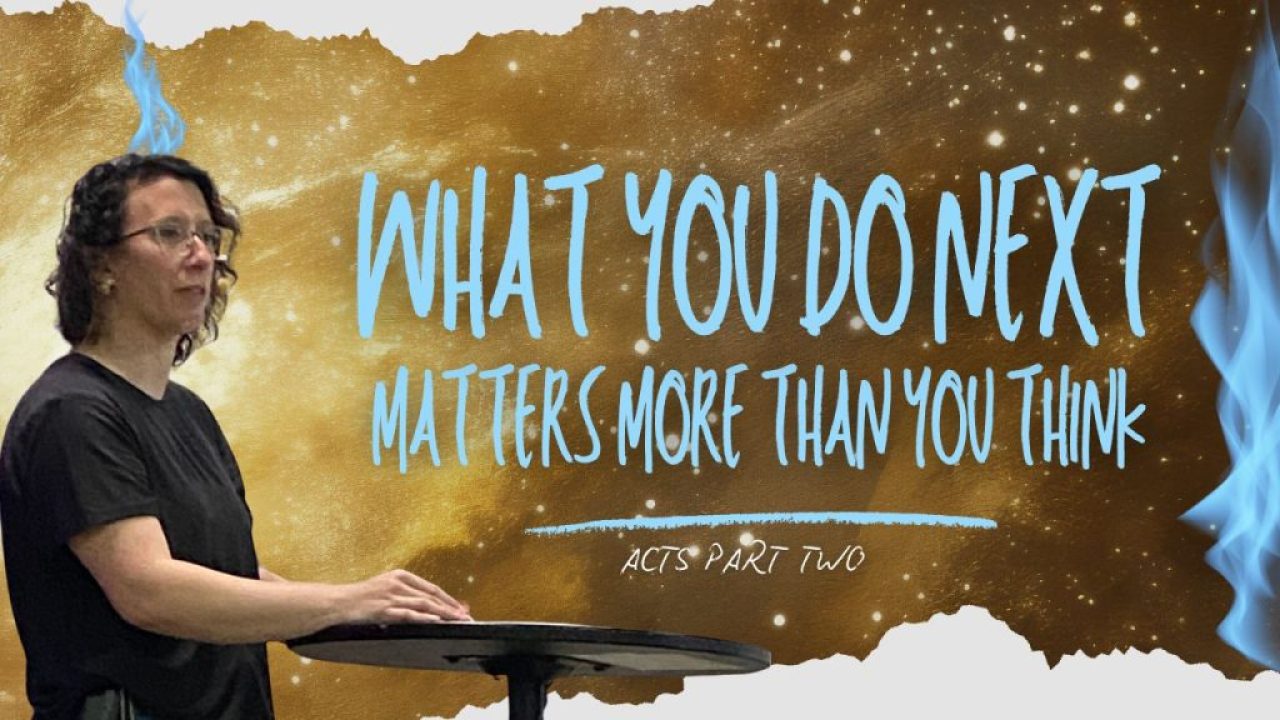
What Shall We Do? | Acts Series Part 2
As part of our Acts series at Open Arms Community Church in Bradford, PA, Melissa Robinson brings a powerful and personal message centered on a question that still confronts every believer today: “What shall we do?” Building on the foundation of the early church after the resurrection, this message walks through conviction, response, and what it really means to follow Jesus in everyday life.
▶️ Watch the Message
A Life Transformed… Again and Again
Last week, we stepped into this series by looking at the early church in the book of Acts, after the resurrection of Jesus.
We saw a group of people whose lives had been completely transformed—not once, not twice, but three times—by Jesus. And He wasn’t done yet.
First, their lives were turned upside down when they chose to follow Him, leaving behind everything they knew. They witnessed His miracles, His teaching, His power.
Then came the crucifixion. One of the darkest moments in history. The One they believed was the Messiah was beaten, tortured, and killed. Their hope seemed lost, and fear drove them into hiding.
Then came the resurrection. Jesus defeated death. Yet even with the empty tomb and eyewitness accounts, doubt and confusion still lingered.
In most of these moments, they didn’t immediately recognize Him. It often took hearing His voice or seeing something familiar for their eyes to be opened.
“Now faith is confidence in what we hope for and assurance about what we do not see.”
Hebrews 11:1
Unbelief can blind us to what God is doing. Faith requires us to trust beyond what we can see.
And through it all, one question remained:
What shall we do?
The Tension of the Question
Hope and belief always demand a response.
You cannot encounter the truth of Jesus and stay the same. At some point, you have to decide what you’re going to do with it.
That tension shows up clearly in the story of the road to Emmaus.
13 Now that same day two of them were going to a village called Emmaus(E-May-Us), about seven miles from Jerusalem.
14 They were talking with each other about everything that had happened.
15 As they talked and discussed these things with each other, Jesus himself came up and walked along with them;
16 but they were kept from recognizing him.
17 He asked them, “What are you discussing together as you walk along?”
They stood still, their faces downcast.
18 One of them, named Cleopas, asked him, “Are you the only one visiting Jerusalem who does not know the things that have happened there in these days?”
19 “What things?”he asked.
“About Jesus of Nazareth,” they replied. “He was a prophet, powerful in word and deed before God and all the people.
20 The chief priests and our rulers handed him over to be sentenced to death, and they crucified him;
21 but we had hoped that he was the one who was going to redeem Israel. And what is more, it is the third day since all this took place.
22 In addition, some of our women amazed us. They went to the tomb early this morning
23 but didn’t find his body. They came and told us that they had seen a vision of angels, who said he was alive.
24 Then some of our companions went to the tomb and found it just as the women had said, but they did not see Jesus.”
25 He said to them, “How foolish you are, and how slow to believe all that the prophets have spoken!
26 Did not the Messiah have to suffer these things and then enter his glory?”
27 And beginning with Moses and all the Prophets, he explained to them what was said in all the Scriptures concerning himself.
28 As they approached the village to which they were going, Jesus continued on as if he were going farther.
29 But they urged him strongly, “Stay with us, for it is nearly evening; the day is almost over.” So he went in to stay with them.
30 When he was at the table with them, he took bread, gave thanks, broke it and began to give it to them.
31 Then their eyes were opened and they recognized him, and he disappeared from their sight. 32 They asked each other, “Were not our hearts burning within us while he talked with us on the road and opened the Scriptures to us?”
33 They got up and returned at once to Jerusalem. There they found the Eleven and those with them, assembled together
34 and saying, “It is true! The Lord has risen and has appeared to Simon.”
35 Then the two told what had happened on the way, and how Jesus was recognized by them when he broke the bread.Luke 24:13–35
Two disciples are walking away from Jerusalem. They’ve seen the crucifixion. They’ve heard about the empty tomb. They know something has happened—but they’re confused, discouraged, and unsure.
They say it plainly:
“We had hoped…”
Their expectations didn’t match reality.
And while they’re walking in confusion, they’re also walking in the wrong direction—away from where God is moving, away from community.
That’s what disappointment does. It isolates. It pulls us back when we most need to lean in.
And in that place, it becomes easy to miss Jesus—even when He’s right there.
When Understanding Is Missing
Jesus responds by taking them back to Scripture.
He shows them that the cross wasn’t a failure—it was the plan all along.
The problem wasn’t that they didn’t know Scripture. It’s that they misunderstood it.
They interpreted it through worldly expectations—power, control, dominance.
And that’s still happening today.
But in God’s kingdom:
- Greatness looks like humility
- Leadership looks like service
- Victory comes through sacrifice
Then in a familiar moment—breaking bread—their eyes are opened.
Everything changes.
They turn around and go back.
Back to community.
Back to where God is moving.
A Changed Life Doesn’t Stay Isolated
When focus shifts to disappointment and frustration, it becomes easy to withdraw from the very people and places where God is working.
But when eyes are lifted and attention turns toward Jesus, even familiar moments become powerful.
Sometimes it takes seeing Him clearly.
Sometimes it takes something simple—like shared bread—to recognize Him again.
And often, it takes the presence of other believers to help us see what we’ve been missing.
A New Kind of Boldness
“Then Peter stood up with the Eleven, raised his voice and addressed the crowd.”
Acts 2:14a
Peter stands up and speaks—and this is not the same man.
This is the one who denied Jesus.
The one who failed.
The one who fell short.
Now he is bold.
Because God doesn’t disqualify people for their failures.
He restores them.
Redeems them.
And uses them.
The Moment of Decision
Peter declares the truth:
36 “Therefore let all Israel be assured of this: God has made this Jesus, whom you crucified, both Lord and Messiah.”
37 When the people heard this, they were cut to the heart and said to Peter and the other apostles, “Brothers, what shall we do?”
38 Peter replied, “Repent and be baptized, every one of you, in the name of Jesus Christ for the forgiveness of your sins. And you will receive the gift of the Holy Spirit. 39 The promise is for you and your children and for all who are far off—for all whom the Lord our God will call.”
40 With many other words he warned them; and he pleaded with them, “Save yourselves from this corrupt generation.” 41 Those who accepted his message were baptized, and about three thousand were added to their number that day.
Acts 2:36–41
Jesus is Lord.
And the people are cut to the heart.
They ask the question:
“What shall we do?”
Conviction without response leads nowhere.
Feeling something is not the same as doing something.
What It Means to Respond
Peter gives a clear answer:
Repent.
Be baptized.
Receive the Holy Spirit.
Repentance is not just feeling sorry—it’s a turning. A change in direction.
Baptism is identifying with Jesus and His people.
The Holy Spirit empowers the new life that follows.
Three thousand people responded that day.
And what did they do?
They stepped into community.
They devoted themselves to teaching, fellowship, and prayer.
They didn’t isolate—they engaged.
The Kind of Witness We Become
5 “A farmer went out to sow his seed. As he was scattering the seed, some fell along the path; it was trampled on, and the birds ate it up. 6 Some fell on rocky ground, and when it came up, the plants withered because they had no moisture. 7 Other seed fell among thorns, which grew up with it and choked the plants. 8 Still other seed fell on good soil. It came up and yielded a crop, a hundred times more than was sown.”
When he said this, he called out, “Whoever has ears to hear, let them hear.”
Luke 8:5–8
The parable of the sower shows that the condition of the heart determines the outcome.
Some hear and never understand.
Some receive it but fall away.
Some are distracted and choked by life.
Some take root and produce fruit.
The question isn’t just how we hear the Word.
It’s how we live it.
What kind of witness will we be?
What kind of disciple maker will we become?
But you will receive power when the Holy Spirit comes on you; and you will be my witnesses in Jerusalem, and in all Judea and Samaria, and to the ends of the earth.
Acts 1:8
Faith That Moves
Faith isn’t just belief—it’s action.
14 What good is it, my brothers and sisters, if someone claims to have faith but has no deeds? Can such faith save them? 15 Suppose a brother or a sister is without clothes and daily food. 16 If one of you says to them, “Go in peace; keep warm and well fed,” but does nothing about their physical needs, what good is it? 17 In the same way, faith by itself, if it is not accompanied by action, is dead.
18 But someone will say, “You have faith; I have deeds.”
Show me your faith without deeds, and I will show you my faith by my deeds. 19 You believe that there is one God. Good! Even the demons believe that—and shudder.
20 You foolish person, do you want evidence that faith without deeds is useless[a]? 21 Was not our father Abraham considered righteous for what he did when he offered his son Isaac on the altar? 22 You see that his faith and his actions were working together, and his faith was made complete by what he did. 23 And the scripture was fulfilled that says, “Abraham believed God, and it was credited to him as righteousness,”[b] and he was called God’s friend. 24 You see that a person is considered righteous by what they do and not by faith alone.
25 In the same way, was not even Rahab the prostitute considered righteous for what she did when she gave lodging to the spies and sent them off in a different direction? 26 As the body without the spirit is dead, so faith without deeds is dead.James 2:14–26
For it is by grace you have been saved, through faith—and this is not from yourselves, it is the gift of God— 9 not by works, so that no one can boast.
Ephesians 2:8–9
Grace saves.
Faith responds.
Action follows.
The Christian life isn’t powered by self—it’s sustained by the Holy Spirit.
Living With Purpose
7 Since you call on a Father who judges each person’s work impartially, live out your time as foreigners here in reverent fear.
18 For you know that it was not with perishable things such as silver or gold that you were redeemed from the empty way of life handed down to you from your ancestors,
19 but with the precious blood of Christ, a lamb without blemish or defect.
20 He was chosen before the creation of the world, but was revealed in these last times for your sake.
21 Through him you believe in God, who raised him from the dead and glorified him, and so your faith and hope are in God.
22 Now that you have purified yourselves by obeying the truth so that you have sincere love for each other, love one another deeply, from the heart.
23 For you have been born again, not of perishable seed, but of imperishable, through the living and enduring word of God.1 Peter 1:17–23
This life is not the final destination.
There is a call to live differently—to love deeply, to walk in reverence, and to reflect the reality of what Christ has done.
This isn’t about empty effort.
It’s about a transformed life marked by obedience, love, and purpose.
The Question Still Stands
So the question comes back again:
What shall we do?
For some, the answer is to respond for the first time.
For others, it’s to turn back after drifting away.
For others, it’s to stop striving alone and begin relying on the Holy Spirit.
The early church didn’t just ask the question.
They answered it.
They acted.
And everything changed.
The Call
Jesus is not passive. He is relentless in His pursuit.
He meets people in their doubt.
He meets people in their failure.
He meets people in their confusion.
He opens eyes.
He softens hearts.
He calls people forward.
16 Then the eleven disciples went to Galilee, to the mountain where Jesus had told them to go. 17 When they saw him, they worshiped him; but some doubted. 18 Then Jesus came to them and said, “All authority in heaven and on earth has been given to me. 19 Therefore go and make disciples of all nations, baptizing them in the name of the Father and of the Son and of the Holy Spirit, 20 and teaching them to obey everything I have commanded you. And surely I am with you always, to the very end of the age.”Matthew 28:16–20
But you will receive power when the Holy Spirit comes on you; and you will be my witnesses in Jerusalem, and in all Judea and Samaria, and to the ends of the earth.”
Acts 1:8
Believe.
Be baptized.
Be a witness.
Make disciples.
And then go and live it out—in love and in the power of Jesus.
Take Your Next Step
If this message challenged or encouraged you, don’t stop here.
Open Arms Community Church meets Sunday mornings at 71 Congress Street in Bradford, PA. If you’re looking for a church in Bradford PA where you can grow, connect, and take your next step in faith—we’d love to meet you.