
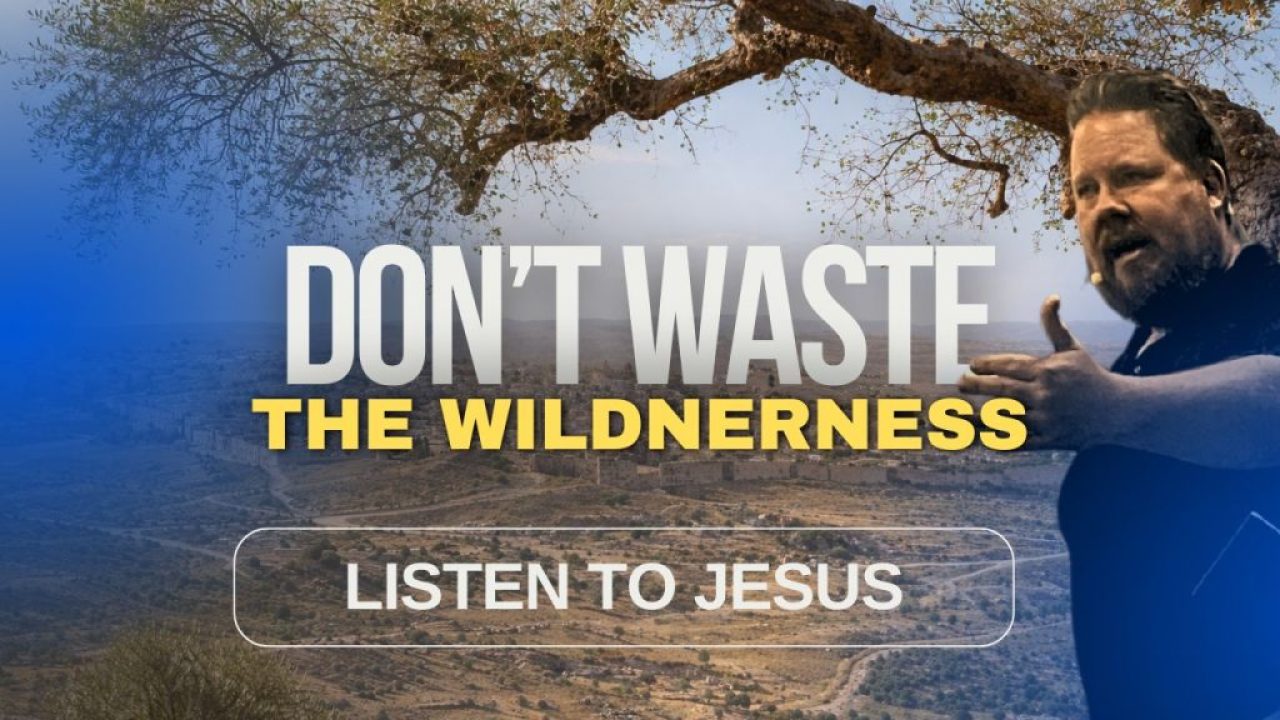
Listen to Jesus: Finding God’s Presence in the Wilderness
Wilderness seasons are rarely something people choose. They often arrive without warning and bring confusion, loneliness, and deep questions. Yet throughout Scripture, wilderness is not only a place of struggle—it is repeatedly a place of encounter.
In this message from the Listen to Jesus series at Open Arms Community Church, Josh Hatcher explores what it truly means to listen to Jesus. Not only to hear His words, but to pay attention to His example, especially His journey into the wilderness before beginning His public ministry.
From the very beginning, God’s design for humanity was not chaos or deprivation, but a garden. God placed Adam and Eve in a cultivated place filled with beauty, provision, and purpose.
The Lord God placed the man in the Garden of Eden to tend and watch over it. But the Lord God warned him, “You may freely eat the fruit of every tree in the garden—except the tree of the knowledge of good and evil. If you eat its fruit, you are sure to die.
Genesis 2:15–17 (NLT)
God did not set humanity up to fail. He gave abundance and one clear boundary. The boundary was not meant to restrict joy, but to protect life. Like a loving parent warning a child about the danger of falling from a great height, God clearly explained the consequence of crossing that line.
The garden was a gift.
But deception entered the story.
The serpent was the shrewdest of all the wild animals the Lord God had made. One day he asked the woman, “Did God really say you must not eat the fruit from any of the trees in the garden?”
“Of course we may eat fruit from the trees in the garden,” the woman replied. “It’s only the fruit from the tree in the middle of the garden that we are not allowed to eat. God said, ‘You must not eat it or even touch it; if you do, you will die.’”
“You won’t die!” the serpent replied to the woman. “God knows that your eyes will be opened as soon as you eat it, and you will be like God, knowing both good and evil.”
The woman was convinced. She saw that the tree was beautiful and its fruit looked delicious, and she wanted the wisdom it would give her. So she took some of the fruit and ate it. Then she gave some to her husband, who was with her, and he ate it, too. At that moment their eyes were opened, and they suddenly felt shame at their nakedness. So they sewed fig leaves together to cover themselves.
Genesis 3:1–7 (NLT)
The serpent’s strategy was subtle. He did not begin with rebellion, but with doubt: Did God really say? That question still echoes today. Eve and Adam chose to trust a different voice, and with that choice came shame, brokenness, and death. Humanity was expelled from the garden into a broken world—a world Scripture often describes as wilderness, where survival would now require sweat, thorns, and struggle.
The wilderness becomes the backdrop of the human story.
Thousands of years later, Jesus steps directly into that same landscape.
Then Jesus was led by the Spirit into the wilderness to be tempted there by the devil. For forty days and forty nights he fasted and became very hungry.
During that time the devil[a] came and said to him, “If you are the Son of God, tell these stones to become loaves of bread.”
But Jesus told him, “No! The Scriptures say,
‘People do not live by bread alone,
but by every word that comes from the mouth of God.’”Then the devil took him to the holy city, Jerusalem, to the highest point of the Temple, and said, “If you are the Son of God, jump off! For the Scriptures say,
‘He will order his angels to protect you.
And they will hold you up with their hands
so you won’t even hurt your foot on a stone.’[”Jesus responded, “The Scriptures also say, ‘You must not test the Lord your God.’”
Next the devil took him to the peak of a very high mountain and showed him all the kingdoms of the world and their glory. “I will give it all to you,” he said, “if you will kneel down and worship me.”
“Get out of here, Satan,” Jesus told him. “For the Scriptures say,
‘You must worship the Lord your God
and serve only him.’”Then the devil went away, and angels came and took care of Jesus.
Matthew 4:1–11 (NLT)
Before preaching publicly. Before performing miracles in front of crowds. Before gathering disciples. Jesus is led by the Spirit into the wilderness.
Not because He failed.
Not because He needed punishment.
But because preparation often happens in hidden places.
Jesus fasts for forty days and faces temptation from Satan. The enemy first appeals to physical hunger, then to pride, and finally to power. None of these temptations are simply about the surface issue. They are all about obedience. Whose voice will be trusted? Whose authority will be followed?
Each time, Jesus responds the same way: with Scripture.
He shows that victory over temptation is not found in willpower alone, but in a heart anchored in God’s Word.
Scripture tells us that this was not the only moment Jesus was tempted.
So then, since we have a great High Priest who has entered heaven, Jesus the Son of God, let us hold firmly to what we believe. This High Priest of ours understands our weaknesses, for he faced all of the same testings we do, yet he did not sin.
Hebrews 4:14–15 (NLT)
Jesus understands human weakness. He knows hunger, exhaustion, desire, grief, and loneliness. Yet He did not sin. Because of this, He stands as both our perfect example and our perfect sacrifice.
The contrast between Adam and Jesus becomes clear.
When Adam sinned, sin entered the world. Adam’s sin brought death, so death spread to everyone, for everyone sinned. Yes, people sinned even before the law was given. But it was not counted as sin because there was not yet any law to break. Still, everyone died—from the time of Adam to the time of Moses—even those who did not disobey an explicit commandment of God, as Adam did. Now Adam is a symbol, a representation of Christ, who was yet to come. But there is a great difference between Adam’s sin and God’s gracious gift. For the sin of this one man, Adam, brought death to many. But even greater is God’s wonderful grace and his gift of forgiveness to many through this other man, Jesus Christ. And the result of God’s gracious gift is very different from the result of that one man’s sin. For Adam’s sin led to condemnation, but God’s free gift leads to our being made right with God, even though we are guilty of many sins. For the sin of this one man, Adam, caused death to rule over many. But even greater is God’s wonderful grace and his gift of righteousness, for all who receive it will live in triumph over sin and death through this one man, Jesus Christ.
Yes, Adam’s one sin brings condemnation for everyone, but Christ’s one act of righteousness brings a right relationship with God and new life for everyone. Because one person disobeyed God, many became sinners. But because one other person obeyed God, many will be made righteous.
Romans 5:12–19 (NLT)
One man’s disobedience brought death to all. One Man’s obedience brings life to all.
Adam failed in a garden full of provision.
Jesus overcame in a wilderness of deprivation.
Where humanity fell, Christ stood firm.
The wilderness theme continues throughout Scripture. Moses encounters God in a burning bush while living in the wilderness. Israel wanders for forty years and is guided by God’s presence as fire and cloud. David hides in caves while being hunted, and some of his most beautiful psalms are written there.
A psalm of David, regarding a time when David was in the wilderness of Judah.
O God, you are my God;
I earnestly search for you.
My soul thirsts for you;
my whole body longs for you
in this parched and weary land
where there is no water.I have seen you in your sanctuary
and gazed upon your power and glory.
Your unfailing love is better than life itself;
how I praise you!
I will praise you as long as I live,
lifting up my hands to you in prayer.
You satisfy me more than the richest feast.
I will praise you with songs of joy.I lie awake thinking of you,
meditating on you through the night.
Because you are my helper,
I sing for joy in the shadow of your wings.
I cling to you;
your strong right hand holds me securely.But those plotting to destroy me will come to ruin.
They will go down into the depths of the earth.
They will die by the sword
and become the food of jackals.
But the king will rejoice in God.
All who swear to tell the truth will praise him,
while liars will be silenced.Psalm 63 (NLT)
Over and over, God reveals Himself in desolate places.
The wilderness is not cursed. It may be hard. It may be lonely. It may be painful. But God’s presence is there.
Personal wilderness seasons often come in many forms—job loss, family crises, health struggles, grief, shame, or fear about the future. These seasons can stir anger, doubt, and honest questions toward God. Yet Scripture never promises a comfortable life. What God promises is His presence.
Even when I walk
through the darkest valley,
I will not be afraid,
for you are close beside me.
Your rod and your staff
protect and comfort me.Psalm 23:4 (NLT)
Sometimes God does not immediately explain the “why.” Sometimes He simply draws near.
Listening to Jesus means slowing down enough to notice that nearness.
An Invitation to Listen
Listening to Jesus means slowing down enough to notice His nearness.
It means allowing space for prayer, reflection, and imagination.
Picture yourself lost, cold, exhausted, and afraid in the wilderness.
Then picture a fire in the distance.
Warmth.
Food.
Light.
Jesus waiting.
Not angry.
Not disappointed.
But welcoming.
“I’ve got you. You’re safe. I’m here.”
What might Jesus be saying in this moment?
The Breastplate of St. Patrick
I arise today through
The strength of heaven,
The light of the sun,
The radiance of the moon,
The splendour of fire,
The speed of lightning,
The swiftness of wind,
The depth of the sea,
The stability of the earth,
The firmness of rock.
I arise today through God’s strength to pilot me,
God’s might to uphold me,
God’s wisdom to guide me,
God’s eye to look before me,
God’s ear to hear me,
God’s word to speak for me,
God’s hand to guard me,
God’s shield to protect me,
God’s host to save me
From snares of devils,
From temptation of vices,
From everyone who shall wish me ill, afar and near.
Against every knowledge that corrupts man’s body and soul,
Christ to shield me today
Against poison, against burning,
Against drowning, against wounding,
So that there may come to me an abundance of reward.
Christ with me,
Christ before me,
Christ behind me,
Christ in me,
Christ beneath me,
Christ above me,
Christ on my right,
Christ on my left,
Christ when I lie down,
Christ when I sit down,
Christ when I arise,
Christ in the heart of every man who thinks of me,
Christ in the mouth of everyone who speaks of me,
Christ in every eye that sees me,
Christ in every ear that hears me.
If this message stirred something in you, we invite you to take a next step.
Support the mission of Open Arms Community Church
Plan a visit and join us on Sunday mornings at 71 Congress Street in Bradford, PA
Into the Wilderness: A Lent Week 3 Reflection - Open Arms Community Church
March 6, 2026 @ 2:13 pm
[…] is a season that we often connect with Jesus and his time in the wilderness. I spoke about this a couple weeks ago at Open Arms.We don’t usually choose the wilderness.It finds […]