What Happens After Salvation? How God Makes Us More Like Jesus
What happens after you become a Christian?
For some people, salvation can almost sound like the end of the story. You believe in Jesus. Your sins are forgiven. You’re saved. Someday you’ll go to heaven. But if that’s all salvation means, it leaves us with an important question: What about the rest of our lives?
What does God want to do in us between the moment we first surrender to Jesus and the day we finally stand in His presence?
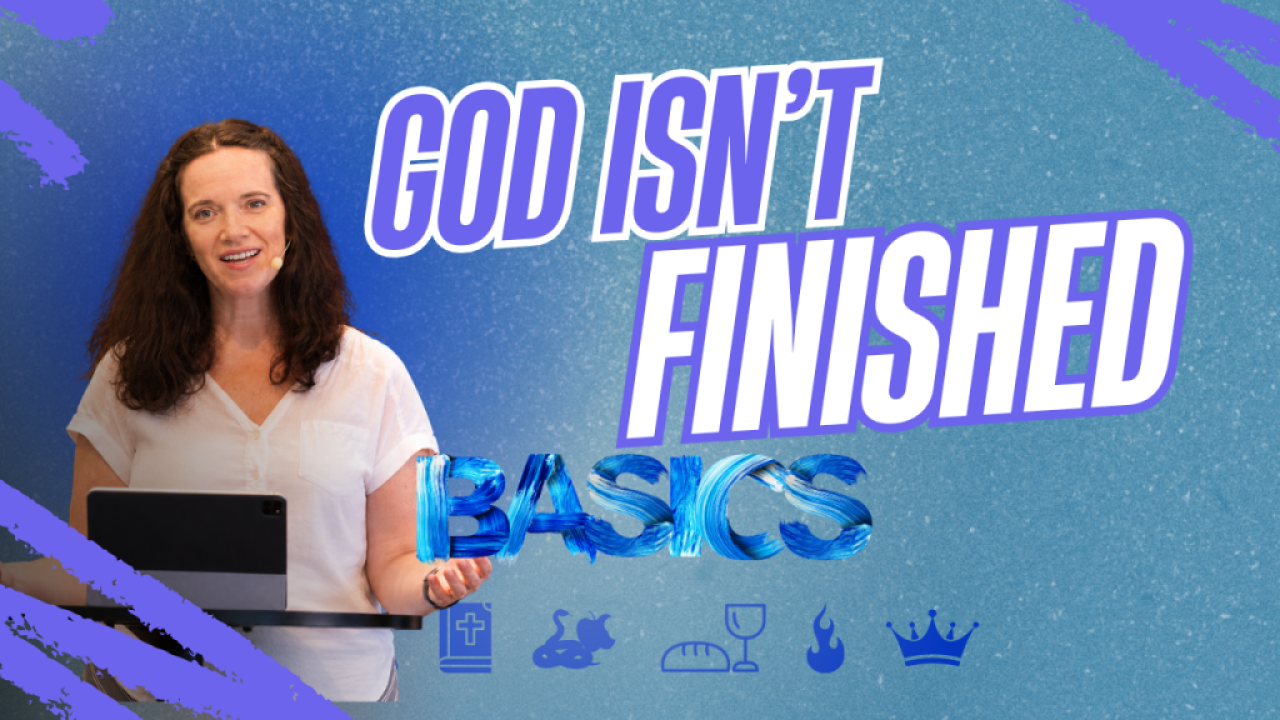
In Part 10 of our Basics series at Open Arms Community Church in Bradford, PA, Pastor Zoe Hatcher explores a word Christians sometimes use without fully understanding: sanctification.
It sounds theological and complicated, but the idea behind it is beautifully practical. God doesn’t simply forgive us and leave us where He found us. He begins changing us. The Holy Spirit works within us, teaching us a new way to live, slowly removing old patterns of rebellion and forming the character of Jesus within us.
Salvation isn’t simply a moment. It’s the beginning of a life with God.
At the heart of this message is the promise found in Colossians 1:22. Through the death of Jesus, our relationship with God has fundamentally changed. We have been reconciled to Him, and now God continues His work in us.
But now he has reconciled you by Christ’s physical body through death to present you holy in his sight, without blemish and free from ac
— Colossians 1:22 (NIV)
Watch the Full Sermon
Watch Pastor Zoe Hatcher’s complete message from Part 10 of the Basics series at Open Arms Community Church.
Please note: Due to a recording issue, the first few minutes of this sermon are missing audio. The teaching from that missing portion is included in the article below.
Salvation Is More Than Being Forgiven
There are three words that help us understand what God does when He saves us: justification, regeneration, and sanctification.
Justification means God sets us right with Himself. Our rebellion is forgiven because of what Jesus has done for us. Regeneration means God gives us new life. We aren’t merely pardoned; we’re welcomed into God’s family and given the ability to follow Christ.
Then comes sanctification.
Sanctification is God’s ongoing work of making us more like Jesus. Justification and regeneration change our standing with God. Sanctification begins changing the way we actually live.
John Wesley compared salvation to a house. Justification is like the porch, and regeneration is like the door. But nobody comes home simply to stand forever in the doorway. You go inside. You live there. And when you begin living in someone else’s house, you quickly discover that every house has its own way of doing things.
Maybe you’ve visited a home where everyone takes their shoes off at the door. If that’s not what you do at home, you have to learn a new habit. You don’t stomp through the living room with muddy shoes and announce, “Well, this is just who I am.” You learn how things work in this house.
The Christian life is something like that. We spent years learning how to live according to the patterns of a broken world. We developed habits and reactions. We absorbed ideas about anger, money, relationships, forgiveness, power, fear, success, and ourselves. Then Jesus welcomes us into His Kingdom. We belong. We’re forgiven. We’re home.
But we still have some mud on our shoes.
That’s where sanctification begins.
Peter describes this new life not as something that happens all at once, but as a process of growth:
But grow in the grace and knowledge of our Lord and Savior Jesus Christ. To him be glory both now and forever! Amen.
— 2 Peter 3:18 (NIV)
Notice that word: grow.
Growth takes time. A seed doesn’t become a mature plant the moment it breaks through the soil. In the same way, being made new in Christ doesn’t mean we instantly understand how to live every part of that new life. God begins teaching us the ways of His house.
Sanctification means becoming holy, and holiness can sometimes be misunderstood. To be holy means to be set apart for God’s intended purpose. God isn’t merely trying to make us behave better or become more respectable people. He’s restoring us so that we can increasingly become who He created us to be.
God Isn’t Just Interested in Your Past
Sometimes we think primarily about salvation in terms of what God has rescued us from: our sin, guilt, rebellion, and death. All of that is wonderfully true. But God also has something He is rescuing us for.
Paul writes:
For we are God’s handiwork, created in Christ Jesus to do good works, which God prepared in advance for us to do.
— Ephesians 2:10 (NIV)
You are God’s handiwork. There is intention behind what He is doing in you. He has purposes for your life, and sanctification is part of how He prepares you to live those purposes.
God isn’t merely erasing your past. He is preparing you for a future.
That means He loves you enough to change the things in you that don’t belong in that future. The old habits, desires, attitudes, and patterns aren’t simply being removed for the sake of following a list of religious rules. God is restoring His original intention for us. He is teaching us to live as people who belong to His family and His Kingdom.
That kind of transformation is far beyond what we can accomplish through willpower alone.
Thankfully, God never expected us to do it alone.
The Whole Trinity Is on the Case
Becoming like Jesus is impossible through sheer willpower. We can make resolutions, promise ourselves we’ll do better, and try harder, but Christianity has never been a self-improvement program. Something supernatural is happening.
First Peter gives us a remarkable picture of the Father, Son, and Holy Spirit all involved in this process:
…who have been chosen according to the foreknowledge of God the Father, through the sanctifying work of the Spirit, to be obedient to Jesus Christ and sprinkled with his blood:
Grace and peace be yours in abundance.
— 1 Peter 1:2 (NIV)
The Father chose us. Jesus Christ cleanses us through His blood. The Holy Spirit sanctifies us. As Zoe put it in the message, “The whole Trinity is on the case.”
We aren’t trying to manufacture holiness by ourselves. Sanctification is the work of the Holy Spirit making us like Jesus so that we can enjoy the kind of relationship with the Father for which we were created. God has been working toward our salvation from the beginning, and He continues that work after we first believe.
And we need that work because being forgiven doesn’t automatically erase everything we’ve learned from living in a broken world.
You Can Take Tarzan Out of the Jungle…
Imagine Tarzan. He’s human, but he didn’t grow up around humans. He grew up in the jungle, so everything he knows about surviving, eating, fighting, communicating, and relating to others comes from the world in which he was raised.
Then he meets other human beings. Suddenly, he’s around people who are like him, but they don’t live anything like him. They wear clothes. They eat with utensils. They read books. They take baths. Tarzan may be human, but he has spent his entire life learning another way to live.
Jane can teach him the human way of doing things, but there’s a problem: she may be able to take Tarzan out of the jungle, but getting the jungle out of Tarzan is another matter.
That’s a surprisingly good picture of what happens to us. Jesus brings us out of an old kingdom and into His Kingdom, but we bring a lot of the old kingdom with us. We carry old habits, old wounds, old desires, old ways of responding when we’re angry or afraid, and old ideas about what will make us happy.
God gets us out of the jungle in a moment. Then He begins getting the jungle out of us.
That’s sanctification.
Surrender Is More Than a Moment
In the previous part of the Basics series, we talked about salvation as surrender. Rebels lay down their weapons, wave the white flag, and become servants of the King. There is a real moment when we surrender to Jesus and acknowledge Him as Lord.
But then we wake up the next morning.
The old ways of thinking don’t necessarily disappear. The old temptations may still be there. The attitudes, reactions, and desires we spent years developing can still feel natural to us.
It takes a moment for a rebel to surrender to the King. It takes much longer to learn how to stop thinking and living like a rebel.
Romans 6 describes this struggle in terms of two different masters:
Don’t you realize that you become the slave of whatever you choose to obey? You can be a slave to sin, which leads to death, or you can choose to obey God, which leads to righteous living. 17 Thank God! Once you were slaves of sin, but now you wholeheartedly obey this teaching we have given you. 18 Now you are free from your slavery to sin, and you have become slaves to righteous living.
19 Because of the weakness of your human nature, I am using the illustration of slavery to help you understand all this. Previously, you let yourselves be slaves to impurity and lawlessness, which led ever deeper into sin. Now you must give yourselves to be slaves to righteous living so that you will become holy.
20 When you were slaves to sin, you were free from the obligation to do right. 21 And what was the result? You are now ashamed of the things you used to do, things that end in eternal doom. 22 But now you are free from the power of sin and have become slaves of God. Now you do those things that lead to holiness and result in eternal life.
— Romans 6:16–22 (NLT)
Before Christ, sin ruled us. Through Jesus, however, we have been set free from sin’s power and can now give ourselves to God. Paul doesn’t describe this as merely believing a different set of ideas. He describes a change in allegiance that begins producing a different kind of life.
Sanctification, then, is the work of moving from being saved by Jesus’ death to becoming imitators of Jesus’ life. We died with Christ, but we didn’t stay dead. Jesus rose again, and in Him we have been given new life. Now we are learning how to live it.
Who Is Forming You?
That raises an important question: Who are you following?
John Mark Comer makes the point in Practicing the Way that if we aren’t being intentionally formed by Jesus, we’re likely being unintentionally formed by someone or something else.
None of us is spiritually neutral. Our families shape us. Our experiences shape us. Our friendships, entertainment, habits, social media feeds, and culture shape us. Every day, we’re surrounded by voices teaching us what matters, what we should desire, what we should fear, what success looks like, and what kind of person we ought to become.
We can tell ourselves, “I’m just doing my own thing,” but even our idea of what our “own thing” should be came from somewhere.
The question isn’t whether you’re being formed. The question is: Who is forming you?
Jesus invites us to become His apprentices. In a skilled trade, an apprentice works closely with a master. The master teaches, corrects, demonstrates, and gives the apprentice opportunities to practice. Over time, the apprentice begins to think about the craft the way the master thinks about it and learns to do what the master does.
That’s a helpful picture of discipleship. We don’t merely believe things about Jesus. We stay close to Him so that we can learn to live like Jesus.
That kind of apprenticeship calls for more than halfhearted obedience. Jesus describes a life given completely to God:
Jesus replied: “‘Love the Lord your God with all your heart and with all your soul and with all your mind.’
— Matthew 22:37 (NIV)
To love God with our whole heart, soul, and mind means there isn’t supposed to be a part of our lives that remains permanently off-limits to Him. Yet if we’re honest, most of us can identify places where our obedience is less than wholehearted. There are things we surrender quickly and other things we hold onto tightly.
So it’s worth asking: How open am I to being changed? When God reveals something in me that doesn’t look like Jesus, am I eager to learn and ready to change? Or does God have to drag me along while I fight Him every step of the way?
Those questions can feel uncomfortable. But God’s desire to change us isn’t evidence that He’s disappointed that we aren’t good enough.
It’s rooted in something much better.
He changes us because He loves us.
God Loves You Too Much to Leave You Unfinished
Being shaped isn’t always comfortable. Sometimes God puts His finger on something we don’t want to surrender. He may expose an attitude we’ve spent years defending, ask us to forgive when we’d rather hold onto resentment, or confront desires and priorities that have become deeply rooted in us.
It’s easy to interpret those uncomfortable moments as evidence that God is displeased with us. But what if they’re actually evidence of His love?
C.S. Lewis explored the idea that we sometimes wish God would be satisfied with less transformation. We’d prefer that He smooth out a few obvious rough edges but leave the deeper parts of us alone. Yet if God settled for less than what He created us to become, that wouldn’t be greater love. It would be less.
God sees what He created you to be. His love means He refuses to abandon His work in you.
Think of an artist working on a masterpiece. Leonardo da Vinci continued working on the Mona Lisa over many years, refining a work that was precious to him. God isn’t casually sketching our lives and then walking away when the work becomes difficult. We are His handiwork, and He remains committed to what He is creating in us.
You are God’s masterpiece, and He isn’t finished with you yet.
That changes the way we understand some of the uncomfortable parts of spiritual growth. God’s correction isn’t proof that He has rejected us. When He reveals something that needs to change, it’s because He knows what that part of our lives can become when it is surrendered to Him.
Stay Soft in the Potter’s Hands
Scripture gives us another powerful picture of God’s transforming work in the story of Jeremiah and the potter.
God sends Jeremiah to a potter’s house, where he watches a craftsman shaping clay on a wheel. When the vessel doesn’t turn out as the potter intended, he doesn’t throw the clay away. He keeps working with it and reshapes it.
The Lord gave another message to Jeremiah. He said, 2 “Go down to the potter’s shop, and I will speak to you there.” 3 So I did as he told me and found the potter working at his wheel. 4 But the jar he was making did not turn out as he had hoped, so he crushed it into a lump of clay again and started over.
5 Then the Lord gave me this message: 6 “O Israel, can I not do to you as this potter has done to his clay? As the clay is in the potter’s hand, so are you in my hand.
— Jeremiah 18:1–6 (NLT)
There’s something both comforting and challenging about that image. The potter hasn’t abandoned the clay because it isn’t finished. His hands are still on it. He still sees what it can become.
But clay has to remain workable.
We can resist what God is doing. We can harden our hearts. We can decide there are certain areas of our lives where God is no longer welcome. Or we can remain surrendered to Him and allow the Potter to keep working.
Maybe one of the most important prayers we can learn to pray is simply: “God, keep me soft in Your hands.”
Keep showing me what doesn’t look like Jesus. Keep exposing the things I’ve carried with me from the old kingdom. Keep reshaping my desires and attitudes. Keep making me into the person You created me to be.
Sanctification requires that kind of openness. God can transform every part of us that we surrender to Him, but He doesn’t force us into submission. We can cooperate with His work or resist it.
You’re Still His Beloved Child
At this point, it’s important to understand something about our identity. God’s ongoing work in us does not mean He’s waiting to love us until we finally get everything right.
Remember the Scripture that opened this message:
But now he has reconciled you by Christ’s physical body through death to present you holy in his sight, without blemish and free from accusation—
— Colossians 1:22 (NIV)
Through Jesus, we have already been reconciled to God. Paul describes us as being presented to Him holy, without blemish, and free from accusation.
That creates an important distinction in the way we understand ourselves:
We are no longer sinners striving to become saints one day. We are saints who sometimes still sin.
That doesn’t minimize sin. Sanctification means God is actively working to free us from the things that don’t belong in our new life. But our failures don’t continually rewrite our identity.
Think about the relationship between a parent and a child. When a child makes a bad choice, that child doesn’t suddenly stop belonging to the family. They may need correction. There may be consequences. They certainly still need to grow. But their failure doesn’t erase the relationship.
The same is true when we belong to God. When we stumble, we’re still His beloved children. The Holy Spirit continues working in us, teaching us to walk more fully in the freedom and holiness that belong to our new identity in Christ.
Some Christians live as though God is constantly reconsidering whether He wants them. They fail and imagine Him backing away. They struggle with an old sin and assume He must be disgusted. They see how far they still have to go and wonder whether anything has really changed.
Sanctification tells a different story.
God is working on you because you belong to Him.
His conviction isn’t rejection. His discipline isn’t abandonment. His shaping isn’t evidence that you’ve failed beyond repair. It’s evidence that His hands are still on the clay.
The places where you aren’t finished yet don’t have to become places of hopelessness. They can become places of surrender.
Salvation Isn’t a Box You Check
It’s possible to think about salvation as though it’s primarily a transaction. We pray a prayer, receive forgiveness, make sure our eternal destination is secure, and then return to life mostly as we knew it before.
But that’s much smaller than the life Jesus offers.
Jesus doesn’t simply invite us to believe enough facts about Him to get into heaven. He invites us to follow Him. Salvation brings us into a relationship with God that begins now, and sanctification is part of learning how to live that new life with Him.
This is why surrender can’t be limited to one moment in our past. There may have been a day when we first said yes to Jesus, but following Him means continuing to say yes. We surrender our habits, our relationships, our plans, our wounds, our ambitions, our fears, and even the parts of ourselves we’ve become accustomed to defending.
Sometimes that surrender happens quickly. Other times, God patiently works on the same place in our hearts for years.
The goal isn’t simply to become a slightly nicer version of the person we used to be. It’s to become more like Jesus.
What Does It Mean to Become Like Jesus?
Becoming like Jesus doesn’t mean losing your personality or becoming a carbon copy of another Christian. God created us with different personalities, abilities, experiences, and purposes. Sanctification isn’t God erasing those differences.
It’s God transforming what sin has distorted.
Our anger can become patience. Our selfishness can become generosity. Pride can give way to humility. Fear can be replaced by trust. Resentment can become forgiveness. Instead of asking only what we want, we begin learning to ask what pleases God and serves the people around us.
This is why holiness is much richer than simply avoiding a list of bad behaviors. Jesus summed up the life God desires with a command that reaches into every part of who we are:
God isn’t looking for one carefully controlled corner of our lives. He wants our whole heart, soul, and mind.
And that means sanctification will eventually reach into places we’d rather keep to ourselves.
What Are You Still Holding Onto?
Most of us probably have areas where surrender comes more easily than others. We may gladly trust God with one part of our lives while keeping a tight grip on another.
We can worship on Sunday and still refuse to forgive someone on Monday. We can trust God with eternity while struggling to trust Him with our finances. We can ask Him to guide our future while quietly insisting that certain plans are nonnegotiable. We can pray for God to change us while hoping He won’t bring up that particular thing again.
This is where sanctification becomes deeply personal.
It’s easy to talk about becoming more like Jesus in general. It’s much harder when the Holy Spirit identifies something specific.
Forgive this person.
Let go of this resentment.
Tell the truth.
Change this habit.
Stop feeding this desire.
Apologize.
Trust Me with this.
The Christian life isn’t merely agreeing that Jesus is right. It’s learning to trust Him enough to obey when His way conflicts with ours.
What Is God Shaping in You Right Now?
Maybe there’s an old habit you’ve been excusing. Maybe there’s resentment you’ve carried so long that it feels like part of your personality. Maybe God has been asking you to forgive someone, confront your pride, change a priority, or surrender something you’ve been determined to control.
Or maybe the work is quieter. Perhaps you’re beginning to notice that your reactions are changing. You’re becoming more patient than you used to be. Something that once controlled you has less power. You’re quicker to recognize when you’re wrong. You’re learning to forgive sooner. You’re beginning to want what God wants.
Don’t dismiss that growth because it isn’t dramatic.
Sanctification is often slow enough that we don’t notice it while it’s happening. But over time, the fingerprints of the Potter begin to appear in the clay.
You don’t have to transform yourself. That’s the Holy Spirit’s work. Your part is to remain surrendered—to listen, obey, repent when necessary, and keep following Jesus.
And when you stumble, you don’t have to assume you’ve returned to the beginning. Get back up. Turn toward your Father again. His hands haven’t left the clay.
God isn’t finished with you. And that’s very good news.
A Prayer of Surrender
Father, thank You for loving me enough not only to forgive me, but to transform me. Thank You that through Jesus I have been reconciled to You and welcomed into Your family.
Holy Spirit, show me the places where I’m still holding onto the ways of my old life. Keep my heart soft in Your hands. Teach me the ways of Jesus. Show me what needs to change, and give me the courage to surrender it when You do.
When I fail, remind me who I am in Christ. When growth feels slow, help me trust that You are still working. I don’t want to simply know about Jesus. I want my life to increasingly look like His.
Make me more like Jesus, one day at a time.
Amen.
Visit Open Arms Community Church in Bradford, PA
If you’re looking for a church in Bradford, PA, we’d love to welcome you to Open Arms Community Church. Come worship with us, meet our church family, and discover what it looks like to follow Jesus together.
Plan Your Visit
Support the Ministry of Open Arms
Your generosity helps Open Arms Community Church continue sharing the Gospel, serving our community, and helping people become more like Jesus as a family.