There’s something different about a space when you’ve had a hand in building it.
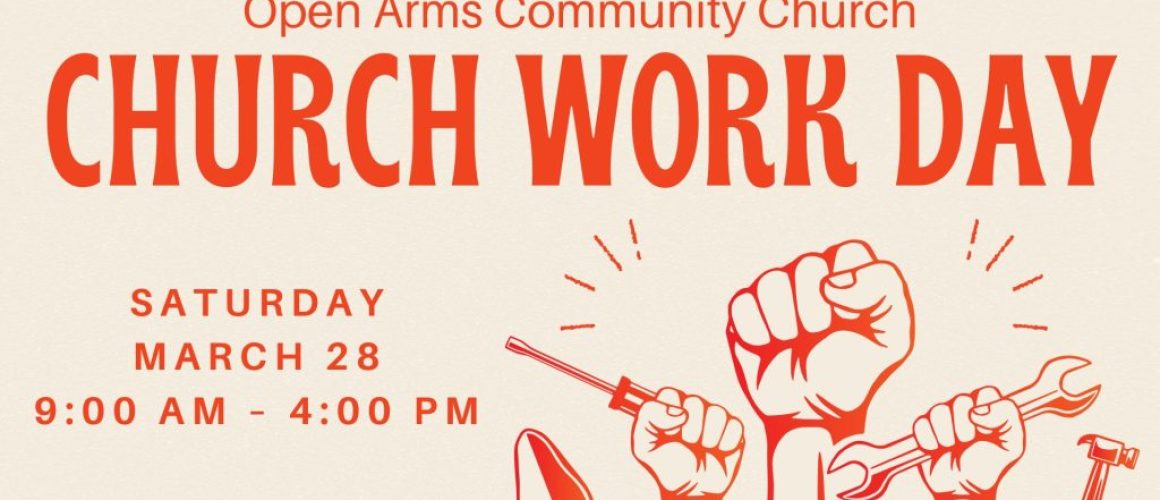
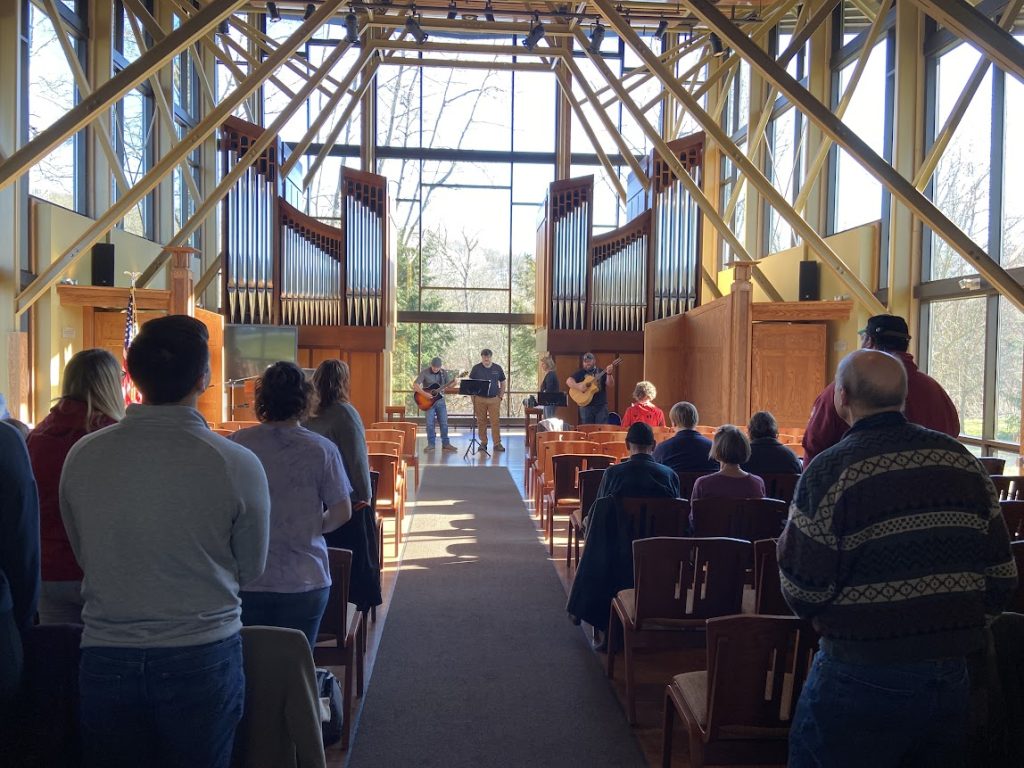
This Saturday, March 28 from 9:00 AM to 4:00 PM, Open Arms Community Church in Bradford, PA is hosting a church work day to prepare our upstairs sanctuary—and we’d love for you to be part of it.
This isn’t just about getting things done. It’s about preparing a place where people will meet Jesus, find healing, and experience real community.
We’re Getting the Space Ready for What’s Next
Right now, there’s a lot happening behind the scenes as we get ready to move upstairs.
We’re not just moving furniture—we’re building out spaces that will serve people every single week.
Some of the work happening includes:
Setting up lighting, cameras, and livestream equipment in the sanctuary
Preparing the stage and worship space
Installing coffee systems and setting up the coffee area
Mounting TVs and getting tech ready for services
Cleaning carpets, pews, windows, and surfaces throughout the building
Fixing doors, thresholds, and other practical needs
Setting up children’s ministry spaces and equipment
General cleaning, organizing, and prepping rooms across the building
Some projects are already in progress. Others will get started this Saturday. All of them move us closer to being ready.
You Don’t Have to Be “Handy” to Help
There’s a place for you, no matter your skill level.
Some jobs require tools and experience. Others just require a willingness to show up and serve.
We’ll have everything from:
Simple cleaning and organizing
Moving furniture
Helping set up rooms
Assisting with projects alongside others
If you can sweep, carry, wipe, or hold something steady—you’re qualified.
This Is More Than a Work Day
This is one of those moments where the church looks like the church.
Not just a service you attend—but a people who build, serve, and show up for each other.
There’s something meaningful about working side by side. Conversations happen. Friendships grow. And there’s a shared sense of purpose that you just don’t get any other way.
And one day soon, people will walk into that upstairs sanctuary…
They won’t see the work that went into it—but they’ll feel it.
Come for an Hour or Stay All Day
We know Saturdays are full.
Come for an hour if that’s what you can do. Stay all day if you’re able.
Every bit helps. Every person matters.
Join Us This Saturday
📍 Open Arms Community Church in Bradford, PA 📅 Saturday, March 28 ⏰ 9:00 AM – 4:00 PM
Wear work clothes. Bring a willing attitude. Maybe invite a friend.
📅 Saturday, April 4 ⏰ 8:00 AM – 8:00 PM 📍 Open Arms Community Church
Spend time in prayer as we prepare for Easter—praying for our lives, our families, our church, and our community.
Throughout the day there will be moments of acoustic worship, and the evening will conclude with a Tenebrae service—a powerful, reflective service that uses light and darkness to remember Christ’s sacrifice.
Holy Week is a time to slow down, reflect, and prepare our hearts for the celebration of Easter.
At Open Arms Community Church in Bradford PA, we are setting aside an entire day for prayer as we wait in the space between the cross and the resurrection.
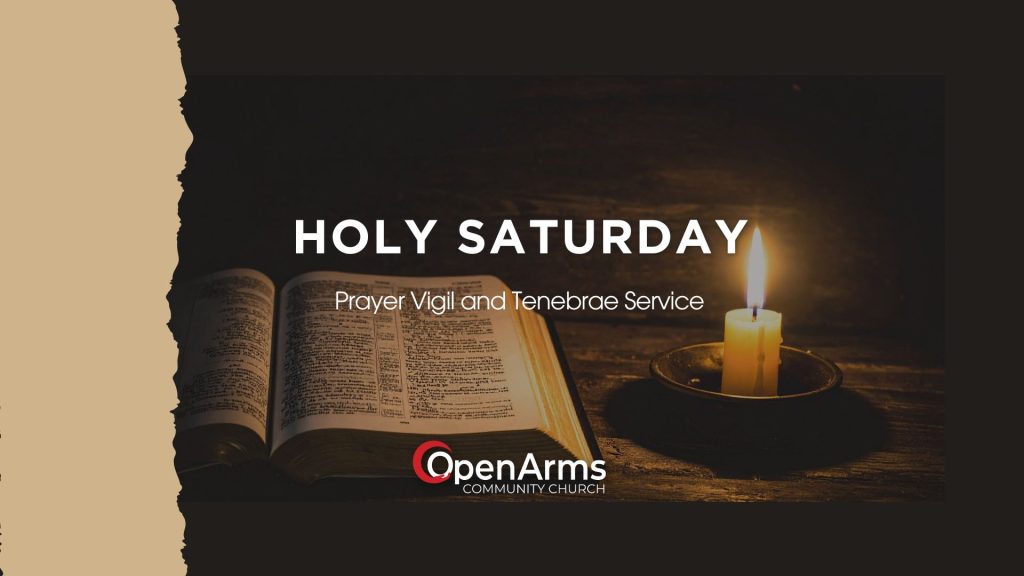
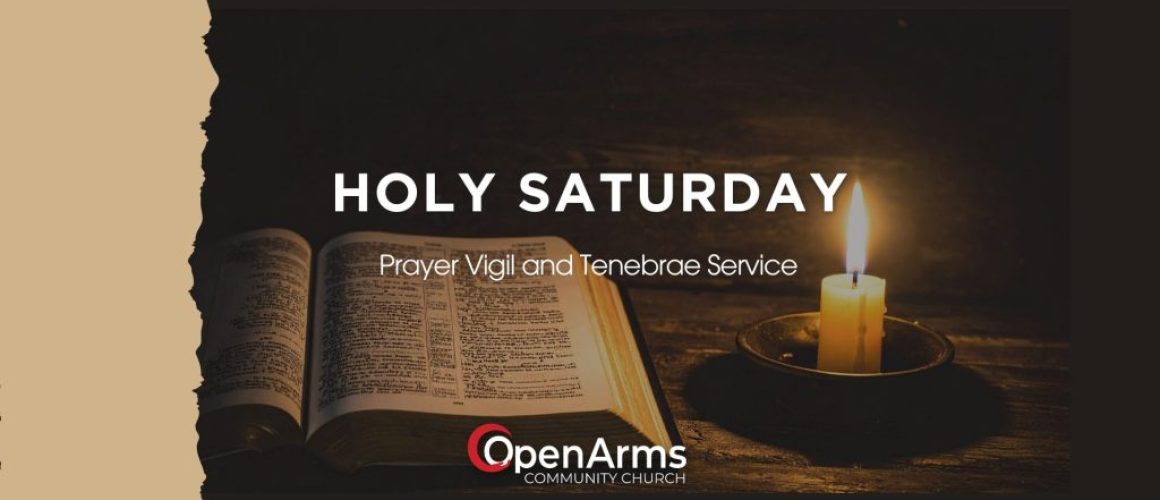
On Saturday, April 4, we invite you to join us for a 12-hour Prayer Vigil, concluding with a powerful and reflective Tenebrae service.
What Is the Holy Saturday Prayer Vigil?
Holy Saturday represents the quiet, in-between moment of Holy Week.
Jesus has been crucified. The tomb is sealed. And the world waits.
The Prayer Vigil is an opportunity to step into that moment—to pause, pray, and reflect on what Christ has done.
Throughout the day, the church will be open for people to come and go as they are able.
You can come for:
• A few minutes of quiet prayer • An hour of focused reflection • Or stay longer as part of the day
We will be intentionally praying for:
• Our personal lives • Our families • Our church • Our community
There will also be times of acoustic worship throughout the day, creating space to reflect, worship, and seek God together.
This is not a rigid, structured service for most of the day, but a space set aside for prayer, worship, and connection with God.
Prayer Vigil Details
📅 Saturday, April 4 ⏰ 8:00 AM – 8:00 PM 📍 Open Arms Community Church
Come for part of the day or the entire time.
What Is a Tenebrae Service?
The day will conclude with a Tenebrae service from 7:00–8:00 PM.
The word Tenebrae means “darkness.”
This is a traditional service that uses light and darkness to help us reflect on the suffering and death of Jesus.
During the service:
• Scripture passages recount the events of Good Friday • Candles are gradually extinguished • The room becomes darker as the story unfolds • The atmosphere invites quiet reflection on Christ’s sacrifice
By the end of the service, the darkness reminds us of the weight of the cross—and prepares us for the hope of Easter morning.
Why This Matters
Holy Saturday is often overlooked, but it is a powerful part of the story.
It is the space between grief and hope. Between loss and resurrection. Between what was and what is about to be.
Taking time to reflect on this moment helps us more fully experience the joy of Easter.
Join Us
If you are looking for a meaningful way to prepare for Easter, we invite you to join us.
At Open Arms Community Church in Bradford PA, we believe moments of prayer and reflection help us reconnect with God and understand the depth of His love.
Whether you come for a few minutes, an hour, or the full Tenebrae service, you are welcome.
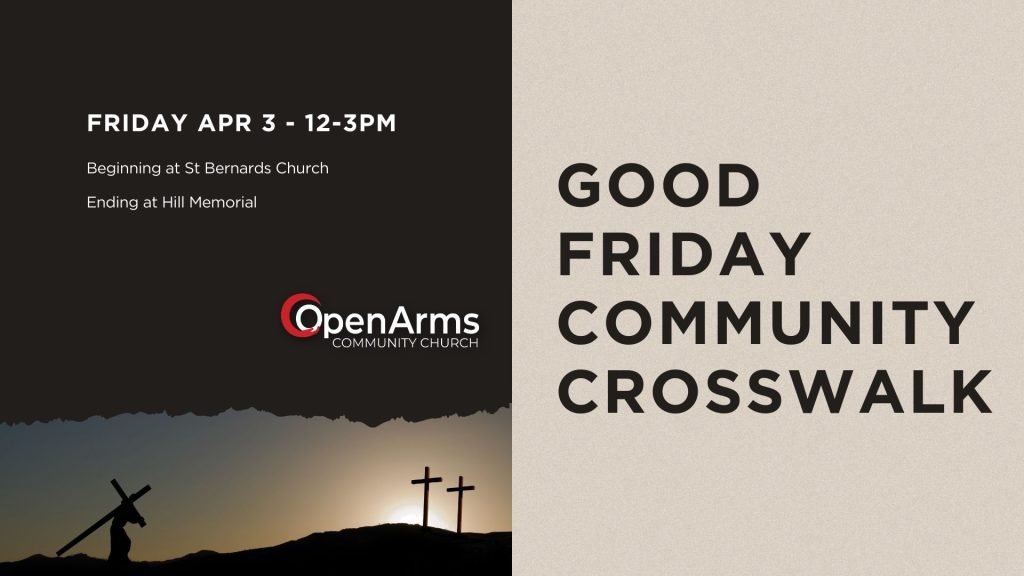
On Good Friday, churches across Bradford will come together for a meaningful community event that reflects on the sacrifice of Jesus Christ.
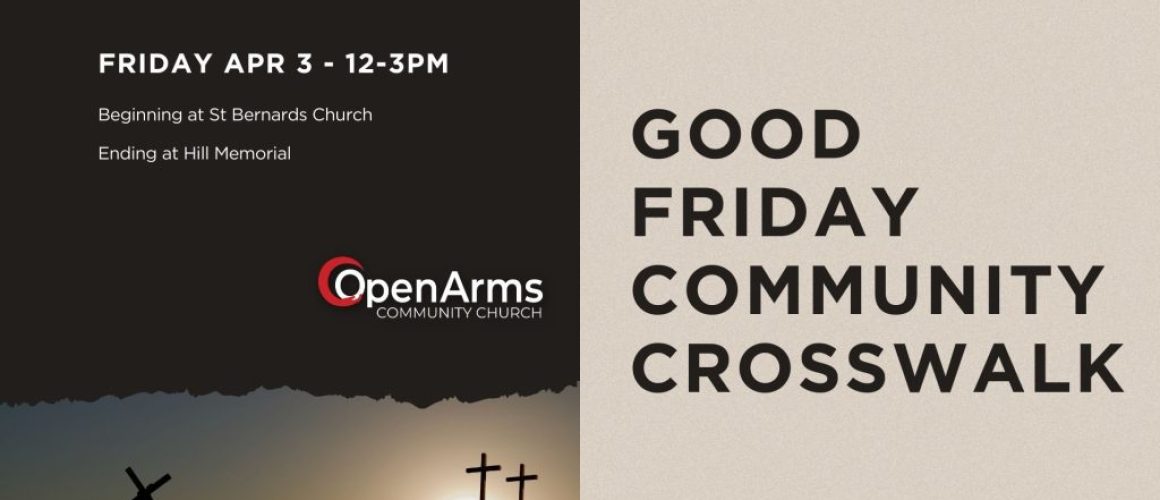
The Good Friday Community Crosswalk, hosted by the Bradford Area Ministerium, invites people to walk together through the Stations of the Cross, stopping at several churches throughout downtown as we remember the events leading to the crucifixion.
This is a powerful opportunity for the Christian community of Bradford to gather in unity during Holy Week.
What Is the Good Friday Crosswalk?
The Good Friday Crosswalk is a long-standing tradition in Bradford, organized by the Bradford Area Ministerium, a network of local churches working together to serve the community.
Each year, the Ministerium hosts this event as a way for churches to come together in a shared expression of faith, reflecting on Christ’s journey to the cross.
Participants walk from church to church, pausing at each location for scripture readings, prayer, and reflection on the Stations of the Cross.
Crosswalk Details
📅 Friday, April 3 ⏰ 12:00 PM – 3:00 PM 📍 Begins at St. Bernard’s
The crosswalk will move through the following churches:
• St. Bernard’s • First United Methodist Church • First Presbyterian Church • Open Arms Community Church • Church of the Ascension • B-Free • Hill Memorial United Methodist Church
Participants are welcome to join for part of the walk or the entire journey.
A Community United in Reflection
The Good Friday Crosswalk is a public, community-centered event that brings together churches from across Bradford.
As the cross moves through the streets, it becomes a visible reminder of Christ’s sacrifice and the unity of the Church in our community.
At the Open Arms Community Church stop, Josh Hatcher will lead a time of singing as participants reflect together.
The Crosswalk will conclude at Hill Memorial United Methodist Church, where Pastor Zoe Hatcher will share a message at the final stop.
Whether you attend one of the participating churches or are simply looking for a meaningful Good Friday event in Bradford PA, you are invited to take part.
Join Us This Good Friday
If you are looking for a meaningful way to observe Good Friday, this is a powerful experience that brings together faith, community, and reflection.
At Open Arms Community Church in Bradford PA, we are honored to be one of the stops along the Crosswalk.
We invite you to join us as we remember the sacrifice of Jesus and prepare our hearts for Easter.
Palm Sunday marks the beginning of Holy Week, a time when we reflect on Jesus’ journey to the cross and prepare our hearts for the celebration of Easter.
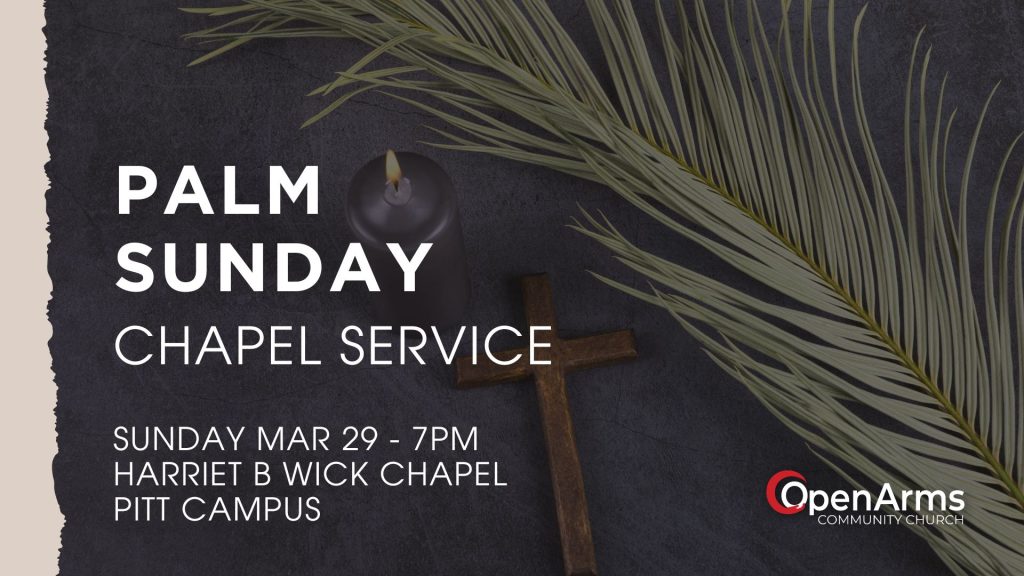
At Open Arms Community Church in Bradford PA, youth and young adults are invited to a special Palm Sunday Chapel Gathering that creates space to worship, reflect, and connect.
Palm Sunday remembers the moment Jesus entered Jerusalem, welcomed by crowds who laid palm branches before Him.
It marks the beginning of the final week of Jesus’ life before the crucifixion and resurrection.
This is a powerful time to pause, reflect, and prepare for everything that Holy Week represents.
Palm Sunday Chapel Gathering Details
Youth will meet at Open Arms Community Church before heading together to the chapel for the service.
📅 Sunday, March 29 🕕 Youth meet at Open Arms at 6:00 PM 🕖 Chapel Service at 7:00 PM 📍 Harriett B. Wick Chapel – Pitt Campus
What to Expect
This gathering is designed to be simple, meaningful, and focused.
The evening will include:
• Acoustic worship • Discovery Bible Study discussion • Communion • Time to reflect and connect with others
This is a great opportunity for young people to step into Holy Week with intention and community.
Who Is This For?
This event is open to:
Youth
Young adults
Whether you’ve been part of church for years or are just beginning to explore your faith, you are welcome.
Join Us This Palm Sunday
If you are looking for a Palm Sunday service in Bradford PA, this gathering is a meaningful way to begin Holy Week.
At Open Arms Community Church in Bradford PA, we believe moments like this help us slow down, reflect, and prepare our hearts for what God wants to do in our lives.
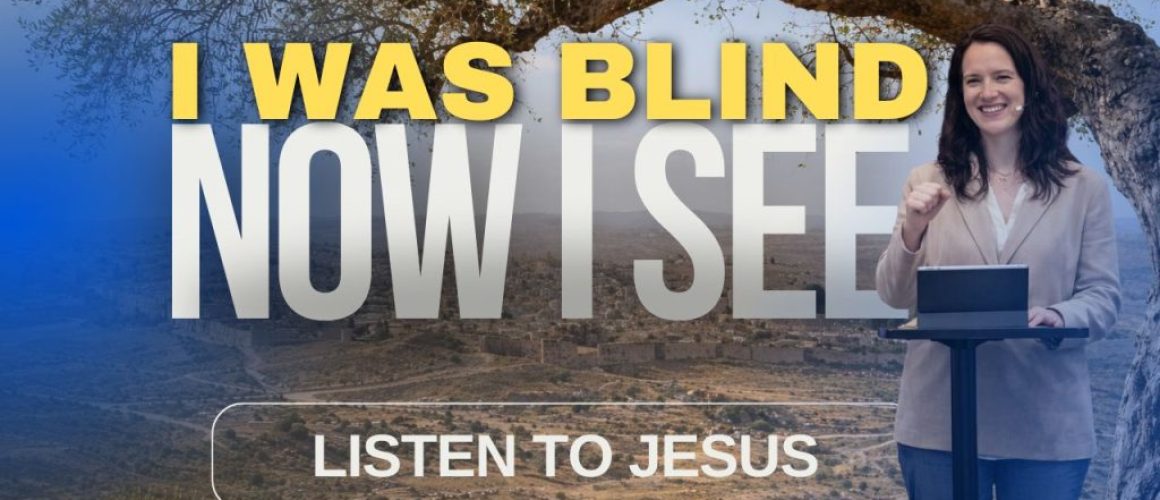
At Open Arms Community Church in Bradford, PA, Pastor Zoe Hatcher continued the Listen to Jesus series with a message from John 9 titled “Now I See.” Throughout this series, we’ve been following Jesus through real moments—on a mountaintop, in the wilderness, in quiet conversations, and at a well. This week, we step into something a little more uncomfortable… a little more real. We see Jesus in the middle of messy ministry—and how people respond when He changes a life.
Watch the Message
John 9 – A Story About More Than Blindness
As he went along, he saw a man blind from birth. His disciples asked him, “Rabbi, who sinned, this man or his parents, that he was born blind?”
“Neither this man nor his parents sinned,” said Jesus, “but this happened so that the works of God might be displayed in him. As long as it is day, we must do the works of him who sent me. Night is coming, when no one can work.5 While I am in the world, I am the light of the world.” John 9:1–5
As Jesus walks along, He sees a man who has been blind since birth.
And right away, the disciples ask the question that so many people still ask today:
Who sinned?
It’s such a natural question—but it comes from a misunderstanding. There was this belief that suffering must be tied directly to sin. That if something is wrong, someone must have done something to deserve it.
But Jesus gently corrects that thinking.
This man’s blindness wasn’t about punishment. It was an opportunity for the work of God to be revealed.
And that’s hard for us sometimes, because we want things to make sense. We want a clear cause and effect. But the reality is—we live in a broken world.
Sometimes people suffer, and there isn’t a simple explanation.
So instead of asking, “Why did this happen?” maybe the better question becomes:
“God, what are You doing here… and how do I trust You in it?”
Messy Ministry – Why Did Jesus Use Mud?
After saying this, he spit on the ground, made some mud with the saliva, and put it on the man’s eyes. “Go,” he told him, “wash in the Pool of Siloam” (this word means “Sent”). So the man went and washed, and came home seeing. John 9:6–7
And then Jesus does something unexpected.
He spits on the ground, makes mud, and places it on the man’s eyes.
It’s messy. It’s uncomfortable. It’s not what anyone would expect.
But nothing Jesus does is random.
This moment echoes something deeper:
Then the Lord God formed a man[a] from the dust of the ground and breathed into his nostrils the breath of life, and the man became a living being. Genesis 2:7
From the very beginning, God formed humanity from the dust of the ground. And here is Jesus—working with that same material.
It’s a reminder that He isn’t just healing something broken.
He is the Creator. He understands the design. He has authority over it.
Then He sends the man to the Pool of Siloam—which means “sent.”
Sent to be healed. And then sent to go and tell.
Four Reactions to Jesus
As the story unfolds, what really stands out isn’t just the miracle—it’s how people respond to it.
And honestly, their reactions feel pretty familiar.
The Disciples – Assumption
They assume there must be a reason. A cause. A sin.
But not everything fits into that kind of equation.
The Neighbors – Skepticism
His neighbors and those who had formerly seen him begging asked, “Isn’t this the same man who used to sit and beg?” Some claimed that he was.
Others said, “No, he only looks like him.”
But he himself insisted, “I am the man.”
“How then were your eyes opened?” they asked.
He replied, “The man they call Jesus made some mud and put it on my eyes. He told me to go to Siloam and wash. So I went and washed, and then I could see.”
“Where is this man?” they asked him.
“I don’t know,” he said. John 9:8–12
The people who had seen this man for years… can’t believe it.
They question him. They doubt him. They even wonder if he’s the same person.
Because sometimes, when something doesn’t fit our understanding, it’s easier to explain it away than to accept that God might have done something miraculous.
The Pharisees – Prejudice
They brought to the Pharisees the man who had been blind. Now the day on which Jesus had made the mud and opened the man’s eyes was a Sabbath. Therefore the Pharisees also asked him how he had received his sight. “He put mud on my eyes,” the man replied, “and I washed, and now I see.”
Some of the Pharisees said, “This man is not from God, for he does not keep the Sabbath.”
But others asked, “How can a sinner perform such signs?” So they were divided.
Then they turned again to the blind man, “What have you to say about him? It was your eyes he opened.”
The man replied, “He is a prophet.” John 9:13–17
The religious leaders don’t celebrate what happened.
They focus on how it happened.
Jesus made mud. It was the Sabbath. That breaks the rules.
And in the process, they completely miss the point.
A man who has never seen in his life… can now see.
And they’re more concerned about the method than the miracle.
It’s a reminder:
It’s possible to be so focused on being right that you miss what God is doing.
The Parents – Fear
They still did not believe that he had been blind and had received his sight until they sent for the man’s parents. “Is this your son?” they asked. “Is this the one you say was born blind? How is it that now he can see?”
“We know he is our son,” the parents answered, “and we know he was born blind. But how he can see now, or who opened his eyes, we don’t know. Ask him. He is of age; he will speak for himself.” His parents said this because they were afraid of the Jewish leaders, who already had decided that anyone who acknowledged that Jesus was the Messiah would be put out of the synagogue. That was why his parents said, “He is of age; ask him.” John 9:18–23
His parents know something real has happened.
But they stay quiet.
Because identifying with Jesus comes with a cost.
And for them, that cost felt too high.
So they step back. They stay safe. They don’t speak up.
And if we’re honest… we’ve probably all been there at some point.
The Man’s Journey of Faith
While everyone else is debating, questioning, and holding back… the man himself is moving forward.
His faith doesn’t arrive fully formed.
It grows.
From Confusion to Clarity
At first, Jesus is just a man.
Then, maybe a prophet.
And then, when pressed, he says:
He replied, “Whether he is a sinner or not, I don’t know. One thing I do know. I was blind but now I see!” John 9:25
“I was blind, but now I see.”
He doesn’t have all the answers. He can’t explain everything.
But he knows what happened to him.
And sometimes, that’s where faith begins.
Standing Firm Under Pressure
A second time they summoned the man who had been blind. “Give glory to God by telling the truth,” they said. “We know this man is a sinner.”
He replied, “Whether he is a sinner or not, I don’t know. One thing I do know. I was blind but now I see!”
Then they asked him, “What did he do to you? How did he open your eyes?”
He answered, “I have told you already and you did not listen. Why do you want to hear it again? Do you want to become his disciples too?”
Then they hurled insults at him and said, “You are this fellow’s disciple! We are disciples of Moses! We know that God spoke to Moses, but as for this fellow, we don’t even know where he comes from.”
The man answered, “Now that is remarkable! You don’t know where he comes from, yet he opened my eyes. We know that God does not listen to sinners. He listens to the godly person who does his will. Nobody has ever heard of opening the eyes of a man born blind. If this man were not from God, he could do nothing.”
To this they replied, “You were steeped in sin at birth; how dare you lecture us!” And they threw him out. John 9:24–34
As the pressure increases, he doesn’t back down.
He speaks honestly. He stands firm.
Even when it costs him.
Even when others are silent.
He chooses to identify with Jesus.
From Belief to Worship
Jesus heard that they had thrown him out, and when he found him, he said, “Do you believe in the Son of Man?”
“Who is he, sir?” the man asked. “Tell me so that I may believe in him.”
Jesus said, “You have now seen him; in fact, he is the one speaking with you.”
Then the man said, “Lord, I believe,” and he worshiped him. John 9:35–38
After everything—after the questions, the pressure, even being cast out—Jesus finds him.
And asks:
Do you believe?
And you can feel the shift.
There’s a desire now. A readiness.
And when Jesus reveals Himself, the response is immediate:
Belief… Surrender… And then worship.
Because when you truly encounter Jesus—when you know what He’s done—
worship becomes the natural response.
Seeing with Spiritual Eyes
This man didn’t just receive physical sight.
He began to see differently.
God Sees Differently
When they arrived, Samuel saw Eliab and thought, “Surely the Lord’s anointed stands here before the Lord.”
But the Lord said to Samuel, “Do not consider his appearance or his height, for I have rejected him. The Lord does not look at the things people look at. People look at the outward appearance, but the Lord looks at the heart.” 1 Samuel 16:6–7
We tend to look at what’s on the surface.
God looks deeper.
And as we grow in faith, He begins to reshape how we see too.
Faith Means Seeing Beyond What’s Visible
Faith isn’t about ignoring reality.
It’s about trusting that God is at work—even when we can’t fully see it yet.
Growth Is the Goal
But grow in the grace and knowledge of our Lord and Savior Jesus Christ. To him be glory both now and forever! Amen. 2 Peter 3:18
Faith is a journey.
It unfolds over time.
And the more we walk with Jesus, the more clearly we begin to see.
The Warning – Spiritual Blindness
Jesus said, “For judgment I have come into this world, so that the blind will see and those who see will become blind.”
Some Pharisees who were with him heard him say this and asked, “What? Are we blind too?”
Jesus said, “If you were blind, you would not be guilty of sin; but now that you claim you can see, your guilt remains. John 9:39–41
At the end of the story, there’s a sobering moment.
The ones who could physically see… were actually blind.
Not because they couldn’t understand.
But because they refused to.
They were too focused on control, on certainty, on being right.
And they missed Jesus completely.
Where Are You on the Journey?
This story invites a response.
Not just reflection—but honesty.
Maybe you’re curious. Maybe you’re unsure. Maybe you’ve seen glimpses of God at work, but haven’t fully stepped in.
Or maybe you’re ready.
Ready to believe. Ready to surrender. Ready to worship.
If you’re exploring faith, asking questions, or ready to take a step—you’re invited.
Join us Sunday mornings at 71 Congress Street in Bradford, PA and experience what God is doing in our community.
👉 Support What God Is Doing
Lives are being changed. People are finding hope, healing, and purpose.
If you’d like to be part of that, you can give here:
This message is part of the Listen to Jesus series at Open Arms Community Church in Bradford, PA — a church where you can find hope, healing, and purpose.
Some churches are built to gather. Others are built to grow. And some – like Open Arms Community Church – are built to GO!
God is moving in EXACTLY that way RIGHT NOW! A brand-new church plant, Free Spirit Redeemer’s Chapel, is launching in Custer City at 68 Minard Run Road. It begins with a soft launch this Friday at 7 p.m., with its official weekly gatherings kicking off on Good Friday (April 3) at 7 p.m.
The latest church plant in the Open Arms Community Church network is a river running freely. As Lead Pastor Zoe Hatcher puts it: “We see the church as a river, not a reservoir.”
Let’s celebrate what happens when a church truly lives out its mission: raising people up and sending them out. Jesus calls us to discipleship. We are listening and obeying!
We hope to see you for the launch. Let’s keep the river flowing (and learn what Free Spirit Redeemer’s Chapel is about).
🎸 Worship That’s Real & Unapologetic
Free Spirit won’t be your typical church experience
Free Spirit Redeemer’s Chapel will take high-energy musical worship to new levels – mixed with raw testimony and Scripture reflection that meets people where they are.
But it’s about authenticity more than volume. Free Spirit will be a space for:
People who may not feel comfortable in traditional settings
People who’ve been through some tough things in life
People who are still figuring it out
In other words: real people. Loving God, Loving people. Sound like the Open Arms mission to you?
🙌 Leadership That Was Built, Not Imported
At the center of this story are Co-Pastors Shawn Pierce and Rich Dennison and their beautiful families.
Their leadership wasn’t hired from the outside. It was built over time – through years of service, friendship, worship, and obedience. Those who’ve attended Open Arms before have likely seen Shawn and Rich on either the praise band stage or working the sound system. (Did we mention they LOVE music?)
“Rich has been my best friend for more than 20 years,” Pastor Shawn said. “We’ve played music together, watched our kids grow up, and walked through ministry side by side.”
They’ve led together. Served together. Grown together. And now – they’re stepping into something new together.
“We’ve been saying, ‘Here I am, Lord, send me,’ for years,” Pierce said. “At some point, you have to stop saying it and start living it.”
That moment is now.
🌱 From Microchurch to Movement
What makes this launch even more powerful is where it came from. Free Spirit Redeemer’s Chapel didn’t just appear overnight. It grew out of The Least of These Riders, a microchurch at Open Arms.
What started as a group of Christian bikers gathering weekly in faith has grown into a full-fledged congregation.
That same model has already led to successful church plants in Port Allegany and Lewis Run. Now, it’s happening again – this time in Custer City with Free Spirit.
If you’re not familiar with microchurches, they’re one of the most impactful shifts Open Arms has made in recent years. Our church reimagines discipleship – not as something that happens in rows of pews, but in circles.
Small, tight-knit groups
Real conversations
Real accountability
Shared burdens
Growth that actually sticks.
(From the EmpowHer women’s group to the Homecoming Recovery addiction support group, we have plenty of microchurches to serve people’s unique needs of spiritual growth and connection.)
It works. That’s why we do it.
People need spiritual nourishment and true human connection during the week, too. We’ve seen true spiritual growth and faith transformation happening in real time. Families aren’t just restored on Sundays. Addictions aren’t toppled by sermons. Lives aren’t redeemed by communion.
These things require ongoing love and attention.
🌊 A Church That Sends, Not Just Gathers
Pastor Zoe describes a river of faith. That’s what Open Arms does.
We don’t just build bigger rooms to fit more people. It builds people, and spirits in Christ don’t grow in confinement.
People who are willing to be shaped.
People who are willing to grow.
People who are willing to go.
“This is what it looks like to trust God with people,” Hatcher said. “Not to hold onto them, but to release them into what He’s calling them to do.”
Free Spirit Redeemer’s Chapel is the next step in that mission. It’s not a copy. It’s not a franchise. It’s a new expression of the same heartbeat — reaching people who feel overlooked, disconnected, or unsure where they belong.
🚪 An Invitation to Something Real
If you’ve ever felt like church wasn’t for you…
If you’ve ever felt like you didn’t quite fit…
If you’ve been looking for something real… Free Spirit Redeemer’s Chapel is it!
Friday nights. Real people. Great music. Honest faith. And a community that’s just getting started.
Because when a river moves, it brings life everywhere it goes.
Have you ever been physically thirsty—so thirsty that a cold drink of water feels like the best thing in the world? In the Bible, thirst is often used as a picture of something deeper: the spiritual longing every human heart carries. We try to satisfy that thirst with comfort, success, relationships, or distractions, but nothing truly fills the emptiness inside. In John 4, Jesus meets a woman who comes to a well looking for ordinary water—and instead offers her something that would change her life forever: living water for the soul.
This past Sunday at Open Arms Community Church in Bradford, PA, Melissa Robinson shared a message as part of our Listen to Jesus series. In Part 4: Living Water, Melissa walks through the story of the Samaritan woman at the well and shows how Jesus meets people right in the middle of their wilderness. Through this encounter, we’re reminded that Jesus doesn’t just address our temporary struggles—He offers something far deeper: a restored relationship with God and a source of spiritual life that never runs dry.
The Bible Tells One Connected Story
One of my favorite things about the Bible is how interconnected the Old Testament and New Testament are. When you really start paying attention, you realize that Jesus didn’t just appear suddenly in the New Testament—He has been present throughout the story from the very beginning.
We know that God is a triune God—Father, Son, and Holy Spirit—and that all three have existed since the beginning of creation.
Throughout the Old Testament we see moments where God reveals Himself in ways that foreshadow Jesus:
Humanity itself, created in the image of God —Genesis 1:27
The mysterious visitors who meet Abraham — Genesis 18
The Angel of the Lord who appears to Moses — Exodus 3
The pillar of cloud and fire guiding Israel —Exodus 13:21
The Ark of the Covenant and the tabernacle — Exodus 25–30
Even the Psalms point forward to Jesus.
A Song of Praise Come, let us sing with joy to the Lord. Let us sing loud with joy to the rock Who saves us. Let us come before Him giving thanks. Let us make a sound of joy to Him with songs. For the Lord is a great God, and a great King above all gods. The deep places of the earth are in His hand. And the tops of the mountains belong to Him. The sea is His, for He made it. And His hands made the dry land.
Come, let us bow down in worship. Let us get down on our knees before the Lord Who made us. For He is our God. And we are the people of His field, and the sheep of His hand. If you hear His voice today, Psalm 95:1–7
In this psalm we see descriptions of the Lord that Christians recognize clearly in Jesus:
The Rock of our Salvation
Our King above all gods
Our Creator
Our Shepherd
When Thirst Reveals the Heart
Psalm 95 refers back to a story in the wilderness when the Israelites were desperate for water.
All the people of Israel left the Desert of Sin, traveling from one place to another as the Lord told them. They set up their tents at Rephidim. But there was no water for the people to drink. So the people argued with Moses, saying, “Give us water to drink.” And Moses said to them, “Why do you argue with me? Why do you test the Lord?” But the people were thirsty there for water. They complained against Moses, saying, “Why did you bring us out of Egypt, to kill us and our children and animals with thirst?” So Moses called to the Lord, saying, “What should I do with these people? They are almost ready to throw stones at me.” The Lord said to Moses, “Pass in front of the people and take some of the leaders of Israel with you. Take the special stick in your hand with which you hit the Nile, and go. See, I will stand before you there on the rock at Horeb. When you hit the rock, water will come out of it and the people will drink.” And Moses did so, with the leaders of Israel watching. He called the name of the place Massah and Meribah because of the arguing of the people of Israel, and because they tested the Lord, saying, “Is the Lord among us or not?”
Exodus 17:1–7
The people had been freed from slavery in Egypt. They had seen the ten plagues. They had watched the Red Sea part before them. They had experienced God’s protection through the pillar of cloud and fire.
And yet when they became thirsty in the wilderness, they doubted.
Their thirst exposed something deeper than physical need—it revealed faithlessness in their hearts.
Jesus Meets Us in the Wilderness
But God didn’t leave humanity wandering in that wilderness forever.
He sent Jesus.
In John 4, Jesus travels from Judea to Galilee and passes through Samaria. Most Jews would go out of their way to avoid Samaria because of the hostility between Jews and Samaritans.
But the text says something interesting.
Jesus had to go through Samaria.
This wasn’t about geography—it was about mission.
At a well near the town of Sychar, Jesus meets a Samaritan woman who has come to draw water.
Jesus knew the proud religious law-keepers had heard He was making and baptizing more followers than John. 2 Jesus did not baptize anyone Himself but His followers did. 3 Then Jesus went from the country of Judea to the country of Galilee. 4 He had to go through the country of Samaria. 5 So He came to a town in Samaria called Sycar. It was near the piece of ground that Jacob gave to his son Joseph. 6 Jacob’s well was there. Jesus was tired from traveling so He sat down just as He was by the well. It was about noon.
7 A woman of Samaria came to get water. Jesus said to her, “Give Me a drink.” 8 His followers had gone to the town to buy food. 9 The woman of Samaria said to Him, “You are a Jew. I am of Samaria. Why do You ask me for a drink when the Jews have nothing to do with the people of Samaria?”
10 Jesus said to her, “You do not know what God has to give. You do not know Who said to you, ‘Give Me a drink.’ If you knew, you would have asked Him. He would have given you living water.” 11 The woman said to Him, “Sir, the well is deep. You have nothing to get water with. Where will You get the living water? 12 Are You greater than our early father Jacob? He gave us the well. He and his children and his cattle drank from it.”
Jesus Tells of the Living Water 13 Jesus said to her, “Whoever drinks this water will be thirsty again. 14 Whoever drinks the water that I will give him will never be thirsty. The water that I will give him will become in him a well of life that lasts forever.”
15 The woman said, “Sir, give me this water so I will never be thirsty. Then I will not have to come all this way for water.”
The True Kind of Worship 16 Jesus said to her, “Go call your husband and come back.” 17 The woman said, “I have no husband.” Jesus said, “You told the truth when you said, ‘I have no husband.’ 18 You have had five husbands. The one you have now is not your husband. You told the truth.”
19 The woman said to Him, “Sir, I think You are a person Who speaks for God. 20 Our early fathers worshiped on this mountain. You Jews say Jerusalem is the place where men should worship.”
21 Jesus said to her, “Woman, believe Me. The time is coming when you will not worship the Father on this mountain or in Jerusalem. 22 You people do not know what you worship. We Jews know what we worship. It is through the Jews that men are saved from the punishment of their sins. 23 The time is coming, yes, it is here now, when the true worshipers will worship the Father in spirit and in truth. The Father wants that kind of worshipers. 24 God is Spirit. Those who worship Him must worship Him in spirit and in truth.”
Jesus Is the One the Jews Are Looking For 25 The woman said to Him, “I know the Jews are looking for One Who is coming. He is called the Christ. When He comes, He will tell us everything.” 26 Jesus said to her, “I am the Christ, the One talking with you!”
27 Right then the followers came back and were surprised and wondered about finding Him talking with a woman. But no one said, “What do You want?” or, “Why are You talking with her?”
28 The woman left her water jar and went into the town. She said to the men, 29 “Come and see a Man Who told me everything I ever did! Can this be the Christ?” 30 They went out of town and came to Him.
Jesus Tells Them of a New Kind of Food 31 During this time His followers were saying to Him, “Teacher, eat something.” 32 He said, “I have food to eat that you do not know of.” 33 The followers said to each other, “Has someone taken food to Him?” 34 Jesus said, “My food is to do what God wants Me to do and to finish His work. 35 Do you not say, ‘It is four months yet until the time to gather grain’? Listen! I say to you, open your eyes and look at the fields. They are white now and waiting for the grain to be gathered in. 36 The one who gathers gets his pay. He gathers fruit that lasts forever. The one who plants and the one who gathers will have joy together. 37 These words are true, ‘One man plants and another man gathers.’ 38 I sent you to gather where you have not planted. Others have planted and you have come along to gather in their fruit.”
The People of Samaria Believe in Jesus 39 Many people in that town of Samaria believed in Jesus because of what the woman said about Him. She said, “He told me everything I ever did.” 40 So the people of Samaria came to Him. They asked Him to stay with them. Jesus stayed there two days. 41 Many more people believed because of what He said. 42 They said to the woman, “Now we believe! It is no longer because of what you said about Jesus but we have heard Him ourselves. We know, for sure, that He is the Christ, the One Who saves men of this world from the punishment of their sins.”
John 4:1–42
Living Water for the Soul
Jesus asks her for a drink of water, which surprises her.
But then He tells her something astonishing.
Jesus said to her, “Whoever drinks this water will be thirsty again.Whoever drinks the water that I will give him will never be thirsty. The water that I will give him will become in him a well of life that lasts forever.” John 4:13–14
The woman thinks Jesus is talking about physical water.
But Jesus is talking about living water.
All throughout the Old Testament, God is described as the source of living water.
As the deer desires rivers of water, so my soul desires You, O God. Psalm 42:1
“Listen! Every one who is thirsty, come to the waters. And you who have no money, come, buy and eat. Come, buy wine and milk without money and without price.” Isaiah 55:1
“For My people have done two sinful things: They have turned away from Me, the well of living waters. And they have cut out of the rock wells for water for themselves. They are broken wells that cannot hold water.” Jeremiah 2:13
“On that day a well of water will be opened for the family of David and for the people of Jerusalem to make them clean from their sin.”
Zechariah 13:1
Worship in Spirit and Truth
The woman tries to shift the conversation to a theological debate about where people should worship.
But Jesus gives a much deeper answer.
“The time is coming, yes, it is here now, when the true worshipers will worship the Father in spirit and in truth. The Father wants that kind of worshipers. God is Spirit. Those who worship Him must worship Him in spirit and in truth.”
John 4:23–24
True worship isn’t about a location.
It’s about the heart.
The Living Water We All Need
Jesus didn’t come just to make life easier.
He came to transform us.
Sin brought:
death
shame
suffering
separation from God
But Jesus came to restore our relationship with the Father.
Jesus said, “I am the Way and the Truth and the Life. No one can go to the Father except by Me.” John 14:6
Jesus is the Way, the Truth, and the Life.
He is the living water our souls need.
Plan Your Visit to Open Arms Community Church
If this message encouraged you or stirred something in your heart, we would love to welcome you.
Join us Sunday mornings at 71 Congress Street in Bradford, PA for worship at 9:00 AM or 11:00 AM.
On Saturday, March 28, we’re inviting our church family and youth to experience one of the biggest nights of Christian music of the year: Winter Jam 2026 at the Bryce Jordan Center in State College, PA.
Winter Jam is the largest annual Christian music tour in the United States, bringing together top artists from across the Christian music world for a powerful evening of worship and encouragement.
This year’s lineup includes artists like Chris Tomlin, Matthew West, Katy Nichole, Hulvey, Disciple, Emerson Day, and Newsong, along with speaker Zane Black.
Event Details
📅 Date: Saturday, March 28, 2026 🕕 Show Time: 6:00 PM 🚪 Doors Open: 5:00 PM 📍 Location: Bryce Jordan Center, State College, PA
One of the great things about Winter Jam is that no tickets are required. Admission is simply a $15 donation at the door, making it an affordable way for youth, families, and friends to experience an incredible night of worship together.
Why We’re Going
This event is a great opportunity to:
Worship together with thousands of believers
Experience live Christian music
Encourage our youth to grow in their faith
Invite friends and families to join us
Events like this help create meaningful moments where students, parents, and church families can encounter God together.
Interested in Joining Us?
This event is open to youth and anyone who wants to attend.
If you have questions or want more information, contact: