🕯️ Push Back the Darkness: Bradford Prayer Vigil A Night of Light, Hope, and Unity in the Heart of Bradford
The headlines in Bradford have been heavy. Our community has faced more than its share of heartbreak — stories of addiction, loss, and tragedy that weigh on all of us. It’s easy to feel like darkness is winning. But on Monday, November 24, the people of Bradford will gather to declare something different: hope still shines here.
Open Arms Community Church invites everyone in the community to join us for the Push Back the Darkness: Bradford Prayer Vigil, a peaceful evening of light and prayer for our city. We’ll meet at 6:30 PM at the Hooker Fulton Building Parking Lot (125 Main Street, Bradford) to pray together before walking through the heart of our community.
Each person is encouraged to bring a flashlight, candle, or lantern — a simple symbol of the light we carry and the faith we share as we pray for Bradford.
This isn’t a protest or demonstration. It’s a moment of unity — families, churches, and neighbors coming together to pray for healing, peace, and transformation across McKean County.
Why We’re Gathering
Our mission at Open Arms has always been to bring hope, healing, and purpose to the people of Bradford. We see the pain our neighbors are walking through — addiction, isolation, broken families, and loss — and we believe the best way to make a difference is to reach people before the crisis takes over.
That’s what this night is about. It’s about showing up, standing together, and reminding one another that light always breaks through the dark.
What to Expect
6:30 PM — Gather at Hooker Fulton Building Parking Lot (125 Main Street) We’ll begin together in prayer, lifting up our city and those who are hurting.
Following Prayer — Community Prayer Walk We’ll walk together through parts of downtown Bradford, carrying flashlights, candles, and lanterns as a visible reminder that hope still lives here.
Closing Moment We’ll gather again for a final prayer and blessing over our city and the people who call it home.
We’ll also be filming moments from the night to share during our GivingTuesday campaign on December 2, helping spread the message that Bradford’s story isn’t over — it’s being rewritten by faith, compassion, and community.
Be Part of the Light
If you’ve ever looked at the headlines and wondered what you could do to help, this is your moment. Bring your light. Bring your faith. Bring your hope for a better tomorrow.
Together, we can push back the darkness and remind our city that God is still moving — and His light still shines in Bradford.
🕯️ Push Back the Darkness: Bradford Prayer Vigil 📅 Monday, November 24 | 6:30 PM 📍 Hooker Fulton Building Parking Lot – 125 Main Street, Bradford, PA
📖 “The light shines in the darkness, and the darkness has not overcome it.” – John 1:5
✨ Help Us Keep the Light Shining
If this vision moves your heart — if you believe in what God is doing through Open Arms to bring hope, healing, and purpose to Bradford — we invite you to join us in making that light shine even brighter.
Your generosity fuels the ministry that reaches people before the crisis hits. It supports our microchurches, recovery groups, community nights, and local partnerships that make real impact every week.
Every gift, no matter the size, helps light another candle of hope in Bradford. Together, we can keep showing our city that the darkness doesn’t get the final word — hope does.
Have you ever spent hours putting together a puzzle, only to realize one piece was missing? The picture looks almost complete—but that single gap draws your eyes every time. You can’t unsee it.
That’s what life feels like when we try to live without community. You might have a career, hobbies, even faith—but without people walking beside you, something vital is missing.
In this message from our Do As I Do series at Open Arms Community Church in Bradford, PA, we explore how Jesus lived in community, why isolation is so dangerous, and how the right relationships can transform your spiritual life.
🕊️ We Were Made for Community
Even in the perfection of Eden, God declared something profound:
Genesis 2:18 (NIV) “The Lord God said, ‘It is not good for the man to be alone. I will make a helper suitable for him.’”
Adam lived in paradise and walked in perfect fellowship with God—yet God still said it wasn’t good for him to be alone. Why? Because we were made in the image of a relational God—Father, Son, and Holy Spirit—eternally connected in community.
That means you and I were designed for relationship. Life apart from meaningful connection was never part of God’s plan.
Author John Mark Comer puts it this way in Practicing the Way:
“Following Jesus isn’t just about believing certain truths in our heads—it’s about adopting His way of life.”
And His way of life was always rooted in relationship.
Imagine a campfire: as long as the coals stay together, they stay hot. But separate one from the pile, and it quickly grows cold. That’s us. Together we burn brighter. Alone we fade out.
🚫 The Danger of the Wrong Community—or No Community at All
Not every group we belong to is good for us. Scripture makes that clear:
Proverbs 13:20 (NIV) “Walk with the wise and become wise, for a companion of fools suffers harm.”
1 Corinthians 15:33 (NIV) “Do not be misled: ‘Bad company corrupts good character.’”
The people around us shape who we become. If you’re trying to grow closer to God, but spend your time with people who pull you in the opposite direction, it’s like trying to swim upstream in a current of compromise.
There are also pseudo-communities—groups that look like real relationships but don’t feed the soul. Social media can make you feel connected, but typed words and emoji hearts can’t replace a hand on your shoulder when you’re hurting.
Workplaces, friend circles, and even online “tribes” can become substitutes for real connection, but without spiritual depth, they leave us empty.
And when we withdraw entirely, isolation becomes the enemy’s playground. Peter warns us:
1 Peter 5:8 (NIV) “Your enemy the devil prowls around like a roaring lion looking for someone to devour.”
Who does the lion attack? The one who strays from the herd. When we believe the lies that “no one understands,” “no one cares,” or “I don’t belong anywhere,” we become easy prey.
That’s why community isn’t optional—it’s essential.
✝️ Jesus Chose Community
If anyone could have done life alone, it was Jesus. Yet He deliberately chose to surround Himself with others.
Luke 6:13 (NIV) “When morning came, he called his disciples to him and chose twelve of them, whom he also designated apostles.”
Jesus lived, ate, prayed, and traveled with His disciples. He shared His most vulnerable moments with His inner circle—Peter, James, and John. Even in the Garden of Gethsemane, as He faced the cross, He asked them to stay and pray with Him.
He also sent His followers two by two—never alone—because He knew the power of shared mission.
If the perfect Son of God didn’t walk alone, why do we think we can?
🕊️ The Early Church: A Model of True Community
After Jesus rose from the dead, His followers didn’t scatter—they gathered.
Acts 2:42–47 (NIV) “They devoted themselves to the apostles’ teaching and to fellowship, to the breaking of bread and to prayer. Everyone was filled with awe at the many wonders and signs performed by the apostles. All the believers were together and had everything in common. They sold property and possessions to give to anyone who had need. Every day they continued to meet together in the temple courts. They broke bread in their homes and ate together with glad and sincere hearts, praising God and enjoying the favor of all the people. And the Lord added to their number daily those who were being saved.”
The early church didn’t grow because of marketing or buildings. It grew because people saw a community of love, generosity, and togetherness unlike anything in the world.
Hebrews 10:24–25 (NIV) “And let us consider how we may spur one another on toward love and good deeds, not giving up meeting together, as some are in the habit of doing, but encouraging one another.”
Real community isn’t just a Sunday handshake—it’s sharing meals, carrying burdens, and walking through life together.
❤️ Why the Right Community Matters
Galatians 6:2 (NIV) “Carry each other’s burdens, and in this way you will fulfill the law of Christ.”
Ecclesiastes 4:9–12 (NIV) “Two are better than one, because they have a good return for their labor: If either of them falls down, one can help the other up. But pity anyone who falls and has no one to help them up. Also, if two lie down together, they will keep warm. But how can one keep warm alone? Though one may be overpowered, two can defend themselves. A cord of three strands is not quickly broken.”
The communities we join will shape the people we become.
The wrong community can pull us down.
No community leaves us vulnerable.
The right community helps us flourish.
John Mark Comer says that spiritual formation happens in three environments: teaching, practice, and community. We can listen to sermons and pray faithfully, but if we’re not rooted in relationships, transformation stalls.
💬 So What Does This Mean for Us?
Ask yourself: Who are my people? Who is my church? The church isn’t a building—it’s a body.
Don’t just attend—belong. Church isn’t a concert where we watch from the crowd—it’s a team where everyone plays a part.
Practice vulnerability. Growth requires honesty. Real connection starts when we stop saying “I’m fine” and start saying “I’m struggling.”
Guard your community. Be wise about who you allow to influence your heart. Not everyone deserves a seat at your table.
Contribute. Community isn’t about consuming; it’s about serving. Look for someone to encourage or lift up today.
John 14:12 (NIV) “Very truly I tell you, whoever believes in me will do the works I have been doing, and they will do even greater things than these, because I am going to the Father.”
This isn’t a solo mission. It’s a community mission.
Alone, you might change one life. Together, we can change the world.
🤝 The Body of Christ
1 Corinthians 12:12–26 (NIV) “Just as a body, though one, has many parts, but all its many parts form one body, so it is with Christ. …The eye cannot say to the hand, ‘I don’t need you!’ …If one part suffers, every part suffers with it; if one part is honored, every part rejoices with it.”
That’s what the church is meant to be—a body where everyone matters, every gift counts, and every person belongs.
Jesus didn’t walk alone, and neither should you.
Community isn’t optional—it’s essential.
Find your place. Open your life. Belong to the body of Christ.
Because together, we can do greater things.
✨ Looking for a Community in Bradford, PA?
Join us Sunday mornings at 71 Congress Street, Bradford, PA. At Open Arms Community Church, you’ll find a place to grow, connect, and belong.
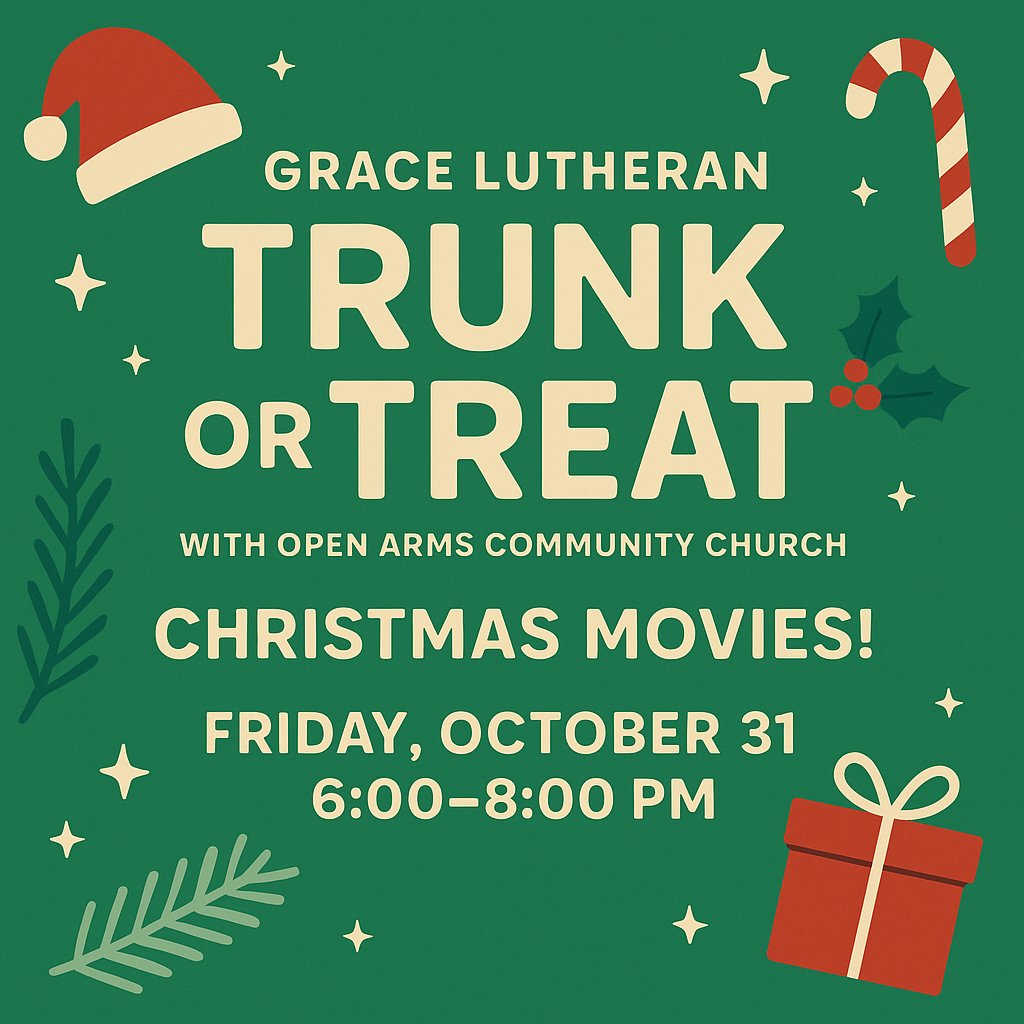
It’s that time of year again — Trunk or Treat is back! 🎃✨ This fall, Grace Lutheran Church and Open Arms Community Church are joining forces once again to bring joy, laughter, and the love of Jesus to families across Bradford, PA.
This year’s theme is “Christmas Movies!” — so get ready to see your favorite holiday classics come to life in the parking lot, complete with costumes, lights, and creative trunk displays that remind us that hope came down at Christmas.
🎁 Event Details
📍 Location: Grace Lutheran Church Community Life Center, Mechanic Street Bradford, PA 📅 Date: October 31 🕓 Trunk Setup: 4:30–5:30 PM 🙏 Opening Volunteer Prayer: 5:45 PM 🎉 Event: 6:00–8:00 PM 🧹 Cleanup: 8:00–8:30 PM
🌟 How You Can Get Involved
We need your help to make this community event shine bright! Whether you’re part of Open Arms, Grace Lutheran, or just someone who loves to serve, there’s a place for you.
We’re looking for volunteers to help with:
Inside games and kitchen
Parking lot monitors
Candy runners
Cleanup crew
Or — decorate your trunk with a fun Christmas movie theme and help make this a night families will never forget!
❤️ Why We Do It
Trunk or Treat is more than just candy and costumes — it’s a way to show our neighbors the joy, love, and generosity of Jesus. Together with Grace Lutheran, we’re building connections, serving our community, and spreading light in a season that can sometimes feel dark.
🎄 Join the Fun
Sign up today to volunteer or host a trunk — and be part of this special night of community and connection. Let’s work together to make this year’s Trunk or Treat the best one yet!
Open Arms Community Church is honored to partner again with Grace Lutheran Church to reach families in Bradford, PA, with hope, fun, and faith.
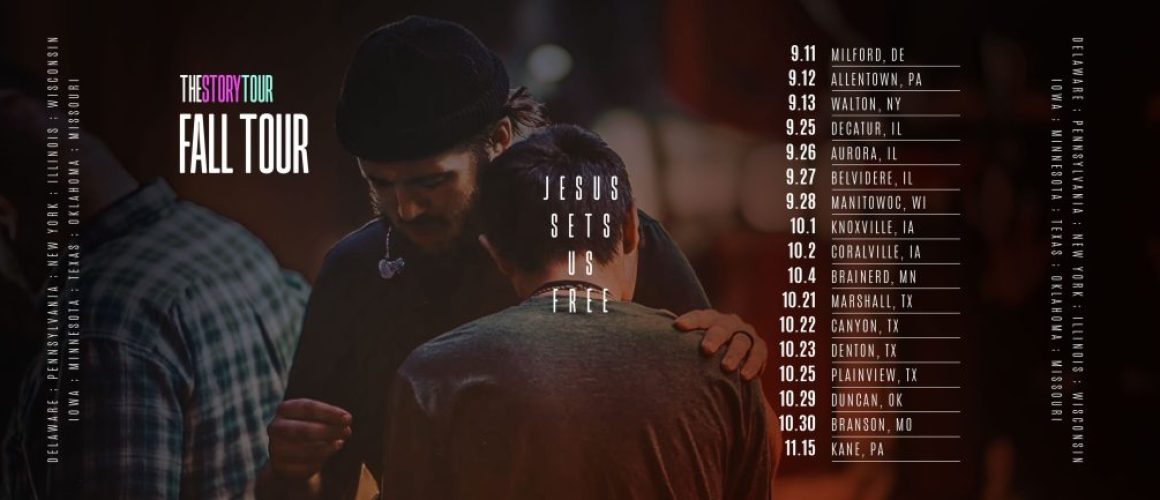
Date: Saturday, November 15, 2025 Location: Kane Area High School (6965 PA-321, Kane, PA 16735)
What is The Story Tour?
The Story Tour is a live event experience built around one truth: “Your story’s not over.” It’s a powerful evening of music, testimony, and ministry, aimed especially at anyone facing a mountain in life—addiction, depression, broken relationships, or simply the challenge of believing there’s more for them.
Highlights of the evening include:
Music by Allan Scott Band, whose lead singer Allan Scott is a former drug-addict turned worship leader and speaker.
Testimony from Travis Habbershon, a suicide-survivor, pastor and author who now lives in Pennsylvania with 16 years clean and sober.
A selection of “God-stories” from around the U.S.—freedom from substance abuse, restoration of marriages, deliverance from depression—offered live and via video.
A welcoming, inter-denominational environment: people from all church backgrounds (or none) are invited to come and receive hope.
“You will leave full of hope and believing that God can restore any situation!”
Why you’ll want to bring others
This isn’t just another concert or speaker event. It’s built around real-life stories of brokenness and redemption. If you or someone you care about is walking through a difficult season—whether addiction, relational pain, mental health struggles or just “I feel stuck”—this evening is designed for you. The website puts it this way:
“Facing unbeatable odds? An addiction? A mountain in your life? ….. Are you the family member of someone dealing with substance abuse? Is your marriage going through a difficult season? … This night was designed for you!”
It also provides a strong opportunity for outreach: invite friends, neighbors, coworkers who might be reluctant to visit a church service but could be drawn to a “night of hope & healing.”
Event Details & Ticket Info
Doors open 5:30 pm (VIP), general admission 6:00 pm, event begins 6:30 pm.
Some testimony and topics may not be suitable for young children—please use your discretion.
Bring your friends, bring someone who needs hope—and come expecting that God can heal any hurt, move any mountain, and restore any situation.
How Open Arms Is Showing Up
At Open Arms Community Church, we believe that hope is something we show up for. The Story Tour isn’t just another event passing through town—it’s an opportunity for us to stand with people in our community who are walking through hard seasons and to remind them that their story isn’t over.
Several of our microchurches will be attending and serving that night—coming together to pray, connect, and support what God is doing through this ministry. We want to be present in the room, ready to encourage, to listen, and to love people right where they are.
Our hope is that everyone who walks through those doors feels the genuine welcome and compassion of Jesus. Whether someone’s coming from a place of addiction, heartbreak, doubt, or just searching for something real—we want them to know they’re not alone.
We’re showing up not just as a church, but as friends, neighbors, and fellow travelers who believe in redemption and new beginnings.
How you can help
Buy your tickets early—and consider inviting someone who might not buy one unless you asked them.
Pray for the event: for Allan, Travis, the band, the testimonies, the setup team, and our church’s team.
Serve on the night if possible: greeting, hospitality, guiding guests, offering follow-up connections.
Follow up with anyone you bring or meet: an event like this can be the beginning of a new chapter, but the real change happens in the days and weeks after.
A final word
If you’ve ever felt like you’re on the edge—maybe you’ve looked at your life and thought “this can’t get any worse,” or “who cares if I try anymore”—this is your invitation to believe that your story’s still being written. The Story Tour isn’t about church-ritual or performance per se, it’s about real lives, broken places, healing steps, and the God who makes all things new.
As the event tagline says: “Heal any hurt. Move any mountain. Restore any situation.”
We are excited to host this powerful night in Kane—and can’t wait to see how God moves through our church body and our community.
There’s something special about gathering around a table with friends — sharing good food, laughter, and gratitude. This November, Open Arms Community Church invites you to our Friendsgiving Community Dinner on Saturday, November 15, from 6:00–7:30 PM!
Whether you’re part of our church family or part of our wider community, you’re welcome to pull up a chair and enjoy a great meal together.
🍗 What’s for Dinner?
Our Community Fun Night team will be serving delicious BBQ chicken. Please bring a picnic-style dish to share — sides, salads, or desserts are all welcome. Potluck vibes, full hearts!
🎬 Cozy Atmosphere
We’ll have A Charlie Brown Thanksgiving playing softly in the background — a simple, nostalgic touch while we eat and connect.
🙌 Open to Everyone
This is a community-wide event. Bring your family, friends, and neighbors. If you’re looking for a friendly place to share a meal and meet people, you belong here.
Join us for an evening of warmth, good food, and friendship as we celebrate the season of gratitude together.
Do As I Do, Part 8 Open Arms Community Church – Bradford, PA
We live in a world full of shifting opinions, unstable foundations, and fragile faith. We scroll, listen, read, and react—but often we build on sand without realizing it.
In this week’s message, Don’t Just Read the Bible — Build Your Life on It, Pastor Zoe reminds us that the strength of our faith doesn’t depend on how much we know—it depends on what we’re standing on.
Because when life gets dark, when the winds pick up, when everything you trusted starts shaking… only one foundation will hold: the Word of God, hidden in your heart and lived out in your life.
We often treat Scripture like a book to read, not a life to build. But Psalm 119 says something deeper:
Psalm 119:9–16 (NIV) 9 How can a young person stay on the path of purity? By living according to your word. 10 I seek you with all my heart; do not let me stray from your commands. 11 I have hidden your word in my heart that I might not sin against you. 12 Praise be to you, Lord; teach me your decrees. 13 With my lips I recount all the laws that come from your mouth. 14 I rejoice in following your statutes as one rejoices in great riches. 15 I meditate on your precepts and consider your ways. 16 I delight in your decrees; I will not neglect your word.
Pastor Zoe shared that the word “hidden” doesn’t mean concealed—it means stored, treasured, kept safe. You don’t wait for the storm to start building the foundation. You lay it now.
💡 When the Lights Go Out
A little girl once got scared when the power went out at home. Her parents told her to grab the lantern from the closet. She didn’t panic—she walked straight to it.
Why? Because she already knew where it was before it got dark.
That’s what it means to hide God’s Word in your heart. When life goes dark, you don’t have to fumble for faith—you already know where to find the light.
“Your word is a lamp for my feet, a light on my path.” — Psalm 119:105 (NIV)
🧱 Building on the Rock
Jesus told a story that gets right to the point:
Matthew 7:24–27 (NIV) 24 “Therefore everyone who hears these words of mine and puts them into practice is like a wise man who built his house on the rock. 25 The rain came down, the streams rose, and the winds blew and beat against that house; yet it did not fall, because it had its foundation on the rock. 26 But everyone who hears these words of mine and does not put them into practice is like a foolish man who built his house on sand. 27 The rain came down, the streams rose, and the winds blew and beat against that house, and it fell with a great crash.”
The difference between the wise builder and the foolish one wasn’t knowledge—it was obedience. Both heard the Word. Only one did something with it.
When we hear without doing, our lives lean like the Tower of Pisa—tilted by time, weakened by shifting ground. But when we hear and do, when we build on the Word, we stand firm no matter what hits.
📚 The Word That Breathes
Paul wrote to Timothy:
2 Timothy 3:14–17 (NIV) 14 But as for you, continue in what you have learned and have become convinced of, because you know those from whom you learned it, 15 and how from infancy you have known the Holy Scriptures, which are able to make you wise for salvation through faith in Christ Jesus. 16 All Scripture is God-breathed and is useful for teaching, rebuking, correcting and training in righteousness, 17 so that the servant of God may be thoroughly equipped for every good work.
The Word of God isn’t just ink on paper—it’s breath. Every verse carries the breath of God Himself. When you read it, it reads you. When you apply it, it forms you. When you obey it, it builds you.
“Is not my word like fire,” declares the Lord, “and like a hammer that breaks a rock in pieces?” — Jeremiah 23:29 (NIV)
💭 Renewing Your Mind
Faith that lasts begins with a renewed mind:
Romans 12:1–2 (NIV) 1 Therefore, I urge you, brothers and sisters, in view of God’s mercy, to offer your bodies as a living sacrifice, holy and pleasing to God—this is your true and proper worship. 2 Do not conform to the pattern of this world, but be transformed by the renewing of your mind. Then you will be able to test and approve what God’s will is—his good, pleasing and perfect will.
Transformation happens when we stop conforming to the noise of culture and start conforming to the voice of Scripture.
The Word doesn’t just inform your life—it forms it.
🔨 Putting It into Practice
The Bible is clear: it’s not enough to read or even memorize Scripture if we never live it out.
Start small.
Open your Bible every day, even for five minutes.
Pick one verse and ask, “What will I do with this?”
Write it down. Pray it back.
Practice it this week until it sticks.
As Pastor Zoe said:
“The goal of reading Scripture isn’t to finish it—it’s to let it finish you.”
✨ A Life That Doesn’t Fall
When your foundation is Scripture, you don’t just survive storms—you grow stronger through them. The winds may shake your house, but they’ll never move the Rock beneath it.
“Heaven and earth will pass away, but my words will never pass away.” — Matthew 24:35 (NIV)
We live in a world that constantly tells us to get more, keep more, and protect what’s ours. But Jesus calls us to something radically different — to give. In this message, part seven of our Do As I Do series, we’re looking at what it means to live generously like Jesus did. Generosity isn’t just about money; it’s a lifestyle of trust, joy, and freedom. When we begin to live under our means and open our hands, we find that God fills them again and again — not so we can store it up, but so we can pour it out.
Pastor Zoe Hatcher | Open Arms Community Church – Bradford, PA
Living the Way Jesus Lived
Doing what Jesus did — that’s what disciples do.
We’ve been walking through this series called Do As I Do: Sabbath. Prayer. Fasting. Solitude. Miracles.
And now, we’re talking about Generosity — the most JOYFUL of all the practices.
But just like the others, generosity is a discipline. It doesn’t just happen on its own. Living a generous life requires focus, practice, and trust.
As we slow down, center our lives around Jesus, and apply these disciplines, our lives simplify. That simplicity frees us up to live under our means — instead of chronically overextended — and opens all kinds of possibilities to bless others.
God Is a Giver
God is a giver — that’s who He is.
He operates in a constant outflow of generous, self-giving, forgiving love. He held nothing back, even giving His only Son for us in the ultimate act of love.
John 3:16 (NIV) “For God so loved the world that he gave his one and only Son, that whoever believes in him shall not perish but have eternal life.”
When we give — our money, our resources, our time, our love — we get to participate in that same divine outflow of love.
That’s what radical generosity looks like. It’s counter-cultural, not normal — but we don’t follow normal, we follow Jesus.
So ask yourself honestly: Are we known as people who give radically? Or as people who take and hoard? Ouch.
A Heart Check for the Church
Let’s be real — most Christians today aren’t known for generosity.
U.S. Christians collectively make $5.2 trillion a year — nearly half of the world’s Christian income.
The average giving per churchgoer is $17 a week — about the cost of a pizza.
That’s $73.67 per month, or $884 per year.
That’s not the heart of our radically generous God. That’s a heart problem — and it’s time we face it.
Be Rich Toward God
Jesus tells a story in Luke 12:13–21 that hits this right on the head:
Luke 12:13–21 (NIV) 13 Someone in the crowd said to him, “Teacher, tell my brother to divide the inheritance with me.” 14 Jesus replied, “Man, who appointed me a judge or an arbiter between you?” 15 Then he said to them, “Watch out! Be on your guard against all kinds of greed; life does not consist in an abundance of possessions.” 16 And he told them this parable: “The ground of a certain rich man yielded an abundant harvest. 17 He thought to himself, ‘What shall I do? I have no place to store my crops.’ 18 “Then he said, ‘This is what I’ll do. I will tear down my barns and build bigger ones, and there I will store my surplus grain. 19 And I’ll say to myself, “You have plenty of grain laid up for many years. Take life easy; eat, drink and be merry.”’ 20 “But God said to him, ‘You fool! This very night your life will be demanded from you. Then who will get what you have prepared for yourself?’ 21 “This is how it will be with whoever stores up things for themselves but is not rich toward God.”
The man’s problem wasn’t saving. It was that he wasn’t rich toward God.
Being rich toward God means choosing generosity — storing up treasures in heaven, not just here on earth.
What It Means to Be “Rich Toward God”
Paul explains this beautifully in 1 Timothy 6:6–11, 17–19:
1 Timothy 6:6–11, 17–19 (NIV) 6 But godliness with contentment is great gain. 7 For we brought nothing into the world, and we can take nothing out of it. 8 But if we have food and clothing, we will be content with that. 9 Those who want to get rich fall into temptation and a trap and into many foolish and harmful desires that plunge people into ruin and destruction. 10 For the love of money is a root of all kinds of evil. Some people, eager for money, have wandered from the faith and pierced themselves with many griefs. 17 Command those who are rich in this present world not to be arrogant nor to put their hope in wealth, which is so uncertain, but to put their hope in God, who richly provides us with everything for our enjoyment. 18 Command them to do good, to be rich in good deeds, and to be generous and willing to share. 19 In this way they will lay up treasure for themselves as a firm foundation for the coming age, so that they may take hold of the life that is truly life.
Radical generosity toward others is being rich toward God.
God’s vision is for His people to live this way — giving out of a ready and cheerful heart, knowing we’re laying up treasures in heaven.
Three Ways to Be Rich Toward God
1. Give a Full Tithe
A tithe is 10% of your income — given to your local church, your spiritual home.
Leviticus 27:30 (NIV) “‘A tithe of everything from the land, whether grain from the soil or fruit from the trees, belongs to the Lord; it is holy to the Lord.’”
That 10% belongs to Him. It’s holy.
Here at Open Arms, we’re sustained solely by what our church family gives. No outside support, no government funding — just faithful giving. And we tithe too! 10% of what you give goes right back out into local and global missions.
Still, the average Christian gives just 2.5%. Imagine if we all gave faithfully — there’d be an extra $139 billion every year for God’s Kingdom!
Malachi 3:8–12 (NIV) 8 “Will a mere mortal rob God? Yet you rob me. “But you ask, ‘How are we robbing you?’ “In tithes and offerings. 9 You are under a curse—your whole nation—because you are robbing me. 10 Bring the whole tithe into the storehouse, that there may be food in my house. Test me in this,” says the Lord Almighty, “and see if I will not throw open the floodgates of heaven and pour out so much blessing that there will not be room enough to store it. 11 I will prevent pests from devouring your crops, and the vines in your fields will not drop their fruit before it is ripe,” says the Lord Almighty. 12 “Then all the nations will call you blessed, for yours will be a delightful land,” says the Lord Almighty.
This isn’t about guilt. It’s about invitation. God says, “Test me in this.”
He’s not trying to take something from you; He’s trying to bless you beyond measure.
Matthew 23:23 (NIV) “Woe to you, teachers of the law and Pharisees, you hypocrites! You give a tenth of your spices—mint, dill and cumin. But you have neglected the more important matters of the law—justice, mercy and faithfulness. You should have practiced the latter, without neglecting the former.”
Jesus Himself affirmed tithing — but He reminded us not to forget why we give.
Hebrews 7:1–2 (NIV) “This Melchizedek was king of Salem and priest of God Most High. He met Abraham returning from the defeat of the kings and blessed him, and Abraham gave him a tenth of everything.”
Abraham gave a tenth before any law commanded it. Why? Because his heart was already generous toward God.
2. Give Sacrificially
Offerings — anything above the tithe — flow from a generous heart.
Mark 12:41–44 (NIV) 41 Jesus sat down opposite the place where the offerings were put and watched the crowd putting their money into the temple treasury. Many rich people threw in large amounts. 42 But a poor widow came and put in two very small copper coins, worth only a few cents. 43 Calling his disciples to him, Jesus said, “Truly I tell you, this poor widow has put more into the treasury than all the others. 44 They all gave out of their wealth; but she, out of her poverty, put in everything—all she had to live on.”
It’s not about the amount — it’s about the sacrifice.
Paul praises the Macedonian church in 2 Corinthians 8–9 for giving joyfully even in poverty, reminding the Corinthians to “excel in this grace of giving.”
3. Give for God’s Eyes Only
Matthew 6:2–4 (NIV) 2 “So when you give to the needy, do not announce it with trumpets, as the hypocrites do in the synagogues and on the streets, to be honored by others. Truly I tell you, they have received their reward in full. 3 But when you give to the needy, do not let your left hand know what your right hand is doing, 4 so that your giving may be in secret. Then your Father, who sees what is done in secret, will reward you.”
This kind of giving — what we call alms — is done in secret. It’s not for applause; it’s for God.
That’s why Open Arms keeps an Alms Box in the back. Everything in it goes straight to help those in need — quietly, humbly, generously.
The Measure You Use
Luke 6:38 (NIV) “Give, and it will be given to you. A good measure, pressed down, shaken together and running over, will be poured into your lap. For with the measure you use, it will be measured to you.”
God measures generosity by our hearts, not our wallets.
If you give with a thimble, you’ll receive a thimble back. But if you give with an overflowing cup — watch how He pours it back, pressed down, shaken together, and running over!
Acts 20:35 (NIV) “In everything I did, I showed you that by this kind of hard work we must help the weak, remembering the words the Lord Jesus himself said: ‘It is more blessed to give than to receive.’”
Making It Practical
Not giving yet? That’s okay. Start small.
If tithing 10% feels overwhelming, start with 1%. Then increase by 1% each paycheck until you reach it.
Put your goal on your prayer card so we can pray with you. The enemy will fight your commitment to generosity — but you won’t fight alone.
The Challenge
Are you ready to commit to generosity and experience the JOY of the Lord through it?
Because when you live open-handed, you’ll discover that God’s hands were open all along.
If this message has stirred your heart, don’t wait to put it into action. Generosity isn’t just something we talk about — it’s something we live. Every gift you give helps us continue sharing the hope of Jesus, serving families in need, and reaching our community with love. Whether you’re starting small or stepping out in faith, your obedience makes an eternal impact. You can give safely and securely anytime at openarmscommunitychurch.org/give. Let’s keep living open-handed and watch what God can do through our generosity.
🕊️ Do As I Do, Part 5 — Solitude: Finding the Secret Place
We all feel it — the constant noise, the notifications, the hurry, the crowds. Our world hums with distractions that keep our souls restless and our minds captive.
But Jesus offers something radically different: An invitation to step away. To be alone with Him — not to escape the world, but to be renewed for it.
“Come with me by yourselves to a quiet place and get some rest.” — Mark 6:31 (NIV)
Through solitude, we are invited into Jesus’ rhythm of retreating from the noise to be fully present with the Father, and then returning to love and serve others.
🌿 Why Jesus Chose Solitude
Jesus made solitude a priority. In a world full of need, pressure, and opportunity, He consistently withdrew to lonely places to pray.
Luke 5:16 (NIV) But Jesus often withdrew to lonely places and prayed.
Jesus often went to solitary or deserted places to commune with God. This wasn’t avoidance — it was alignment. It was a deliberate choice to escape the demands of ministry and people so He could receive spiritual guidance, power, and rest.
If Jesus needed that space, so do we. Solitude demonstrates priorities — it shows what matters most.
🔄 The Rhythm of Retreat and Return
Solitude was never a one-time act for Jesus; it was His rhythm of life. Like breathing in and out, He practiced a pattern of retreat and return.
Matthew 14:22–23 (NIV) Immediately Jesus made the disciples get into the boat and go on ahead of him to the other side, while he dismissed the crowd. After he had dismissed them, he went up on a mountainside by himself to pray. Later that night, he was there alone.
He sent His disciples ahead so He could withdraw in solitude. Later, He returned to continue His mission. This rhythm — inhale with God, exhale into the world — sustained everything He did.
🌤️ When Jesus Invited His Disciples to Rest
Even the disciples, busy with ministry and service, were invited to this same rest.
Mark 6:30–32 (NIV) The apostles gathered around Jesus and reported to him all they had done and taught. Then, because so many people were coming and going that they did not even have a chance to eat, he said to them, “Come with me by yourselves to a quiet place and get some rest.” So they went away by themselves in a boat to a solitary place.
Jesus didn’t say, “Work harder” — He said, “Come away.” He understood that spiritual strength flows from spiritual stillness. Without time alone with the Father, even good things eventually become draining things.
🕯️ The Foundation of Spiritual Life
Henri Nouwen once wrote:
“Without solitude, it is virtually impossible to live a spiritual life.”
Solitude is foundational because it roots every other practice — prayer, Sabbath, fasting, and service — in love rather than performance.
Yet solitude isn’t always easy. It can be deeply refreshing, but it can also feel like painful emotional surgery. When we slow down, the things we’ve buried — grief, regret, fear, anger — begin to rise to the surface. But God brings these things up not to wound us, but to heal us.
In solitude, God forms us into the people He has always desired us to become.
⚔️ The Battles of the Soul
In solitude, we face the same three enemies that Scripture names again and again:
The world — the noise and distractions that keep us from hearing God.
The flesh — the restless desires that crave control and comfort.
The devil — the deceiver who distorts truth.
But solitude is where truth starts to win. When the noise dies down, the voice of God becomes clear again.
🤼♂️ Wrestling with God
Solitude isn’t always serene — sometimes, it’s a wrestling match. One of Scripture’s most profound encounters in solitude happened with Jacob.
Genesis 32:22–30 (NIV) That night Jacob got up and took his two wives, his two female servants and his eleven sons and crossed the ford of the Jabbok. After he had sent them across the stream, he sent over all his possessions. So Jacob was left alone, and a man wrestled with him till daybreak. When the man saw that he could not overpower him, he touched the socket of Jacob’s hip so that his hip was wrenched as he wrestled with the man. Then the man said, “Let me go, for it is daybreak.” But Jacob replied, “I will not let you go unless you bless me.” The man asked him, “What is your name?” “Jacob,” he answered. Then the man said, “Your name will no longer be Jacob, but Israel, because you have struggled with God and with humans and have overcome.” Jacob said, “Please tell me your name.” But he replied, “Why do you ask my name?” Then he blessed him there. So Jacob called the place Peniel, saying, “It is because I saw God face to face, and yet my life was spared.”
Jacob’s story is a reminder that solitude may not always feel peaceful. Sometimes, it feels like a fight — a fight with fear, with guilt, with God Himself. But notice: Jacob left that encounter limping… and blessed. The limp became a reminder of grace — that in weakness, he had met the living God.
🕰️ Steps to Practicing Solitude
Solitude rarely happens by accident; it must be chosen intentionally. Here are simple, practical steps to begin cultivating this rhythm:
Schedule Time and Place Select a consistent time and a quiet location free from interruptions. Make it part of your daily rhythm.
Eliminate Distractions Turn off your phone. Silence notifications. Let your family or coworkers know you’ll be unavailable for a short time.
Start Small Begin with 15–30 minutes. It doesn’t need to be hours — just a moment of intentional presence.
Set a Timer Use a timer so you’re not tempted to check the clock. This helps your mind settle.
Focus Your Attention You might focus on your breathing, a short verse, or simply the beauty of your surroundings. Let your attention rest on God.
Observe and Accept When thoughts or emotions arise, don’t fight them. Acknowledge them and gently return to your focus. Solitude is not about perfection — it’s about presence.
🌤️ The Rewards of Solitude
What happens when you actually make space for solitude?
Self-Reflection: You become aware of your inner life — your motives, wounds, and longings.
Spiritual Growth: You begin to hear God’s voice with clarity.
Peace and Calm: Studies — and Scripture — show that stillness reduces anxiety and renews strength.
Identity: You remember who you truly are — a beloved child of God, not defined by productivity or approval.
Solitude restores what hurry steals.
🌿 The Secret Place
Jesus spoke clearly about solitude in His teaching on prayer:
Matthew 6:6 (NKJV) “But you, when you pray, go into your room, and when you have shut your door, pray to your Father who is in the secret place; and your Father who sees in secret will reward you openly.”
The “secret place” isn’t necessarily a physical room — it’s a posture of the heart. It’s any space where you can be honest, unguarded, and still before God.
This might be:
A park bench at sunrise 🌅
A quiet walk after work 🚶♂️
A fishing spot 🎣
Your bedroom late at night 🌙
Even a locked bathroom if that’s the only quiet spot available 🚪
The place isn’t sacred — His presence is.
💬 Why We Resist Solitude
Even though we long for peace, many of us avoid solitude. We fill every gap in the day with noise or movement. Underneath, there’s a deeper battle happening — a push-pull dynamic of the heart.
Part of us desires God and His will. Another part of us resists Him — wanting to rule our own kingdom.
We say:
“I’m too busy.” “I’ll pray when I have time.” “I just can’t slow down.”
But busyness is one of the enemy’s most effective weapons. Hurry keeps us from hearing the voice that matters most.
We must ruthlessly eliminate hurry from our lives. The stakes are high — peace or exhaustion, presence or burnout, life or death of the soul.
🎸 Less Is More
In the 1980s, Gibson Guitars ran an ad for their Les Paul model that said, “Les is more.”
That phrase captures a profound spiritual truth. When we simplify — when we do less, hurry less, scroll less — we begin to notice more. More peace. More awareness. More of God.
Less noise, more presence. Less striving, more surrender. Less distraction, more delight.
🔥 The Fruit of Solitude
Solitude isn’t about escape; it’s about empowerment. When you retreat with God, you return refreshed and ready to love.
Through solitude we:
Heal from inner wounds.
Hear God’s voice more clearly.
Gain spiritual strength to stand against the enemy.
Learn to love from overflow rather than exhaustion.
Without the quiet, our spiritual lives wither. But with it, we come alive to the greatest joy of life — a familiar friendship with Jesus.
💛 Find the Quiet — Find God
Each of the spiritual practices — Sabbath, prayer, fasting, solitude — is designed to keep us connected and aligned with the heart of the Father.
As we make space for the secret place, our souls begin to wake up. A holy flame starts to burn again. And in that flame, we rediscover what Jesus meant when He said:
“Come and see.” — John 1:39 (NIV)
He invites you not just to believe in Him, but to be with Him. In the quiet. In the secret place. In the stillness where His love restores your soul.
So find your secret place — wherever that may be — and go there often. Fall in love with it. Fall in love with Him.
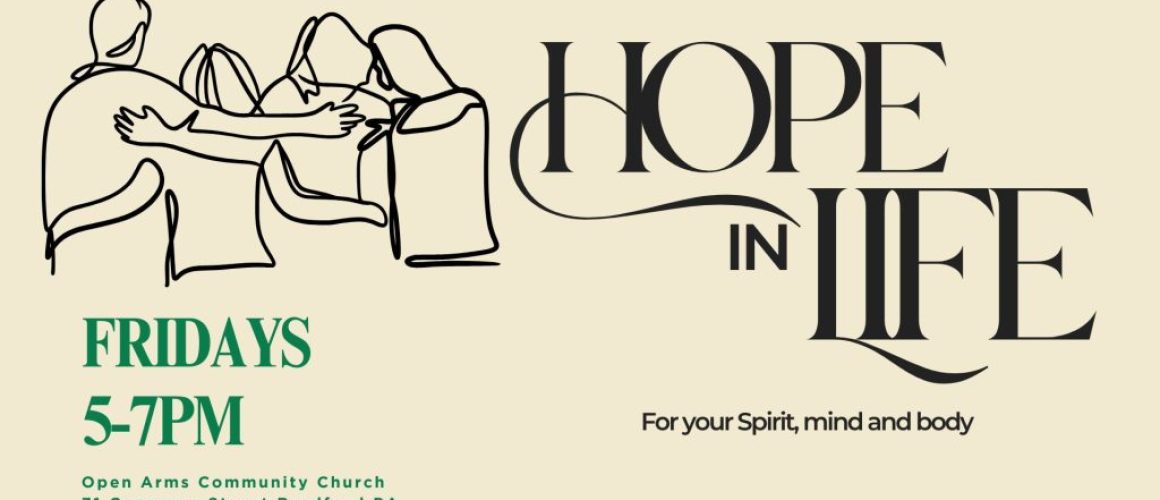
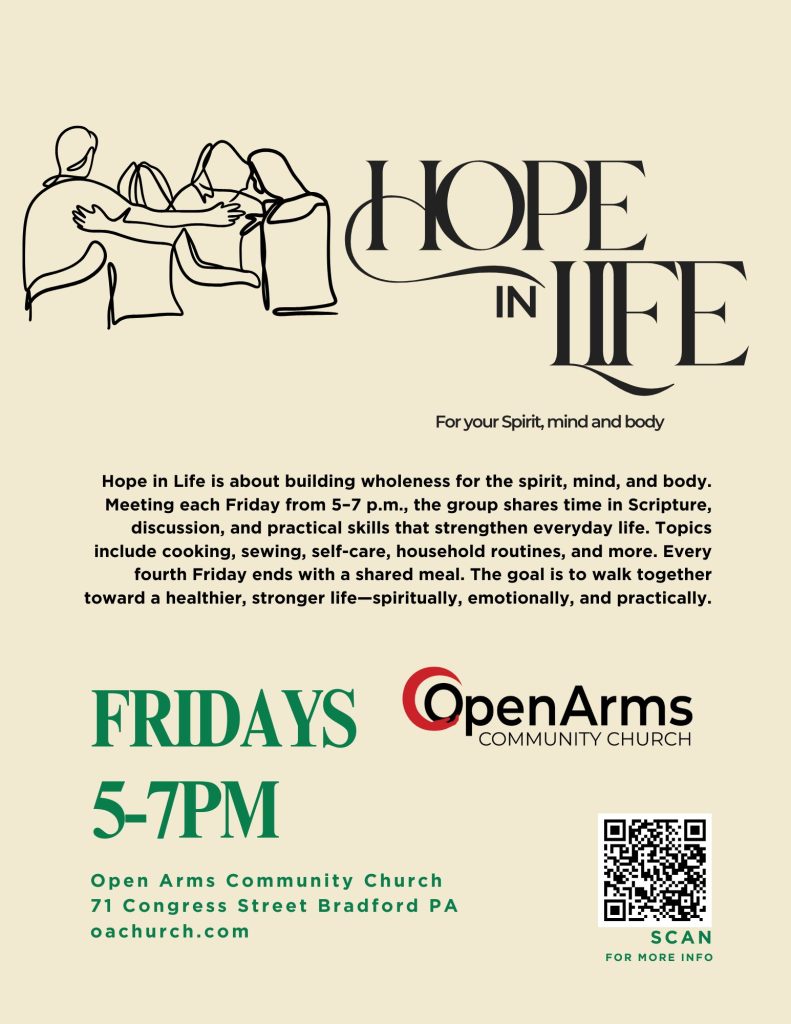
Open Arms Community Church in Bradford, PA is launching a new microchurch called Hope in Life, led by Angel Atkinson. This weekly gathering is designed to nurture the whole person—spirit, mind, and body—through faith, conversation, and hands-on learning.
Hope in Life meets every Friday evening from 5–7 p.m. Each week includes a time in the Bible, space for group discussion, and an opportunity to practice a new skill. The focus changes weekly, from cooking and sewing to self-care, cleaning, or even understanding emotions. On the fourth Friday of each month, the group hosts a shared dinner, creating an atmosphere of friendship and community.
Angel’s heart for this ministry is to provide a place where practical tools and spiritual encouragement come together. By offering both, Hope in Life helps participants grow stronger in faith while also equipping them with everyday skills that build confidence and hope.
Why Hope in Life Matters
True wholeness touches every part of life. Struggles with daily routines can often weigh down the heart, just as spiritual burdens can make even simple tasks feel overwhelming. Hope in Life creates a safe place where people can find encouragement, learn together, and discover that God cares about their entire well-being—spirit, mind, and body.
Refer Someone Who You Know
Hope in Life is not just for those who already know what they need. Sometimes the best way to help is simply to extend an invitation. Friends, neighbors, or family members may benefit from a group like this even if they would never ask for it themselves. Referrals are a vital part of this ministry—pointing someone toward a supportive community can open the door to healing, growth, and renewed hope.
Hope in Life meets every Friday from 5–7 p.m. at Open Arms Community Church in Bradford, PA, and is led by Angel Atkinson. This microchurch is committed to walking alongside people as they grow stronger spiritually, emotionally, and practically.
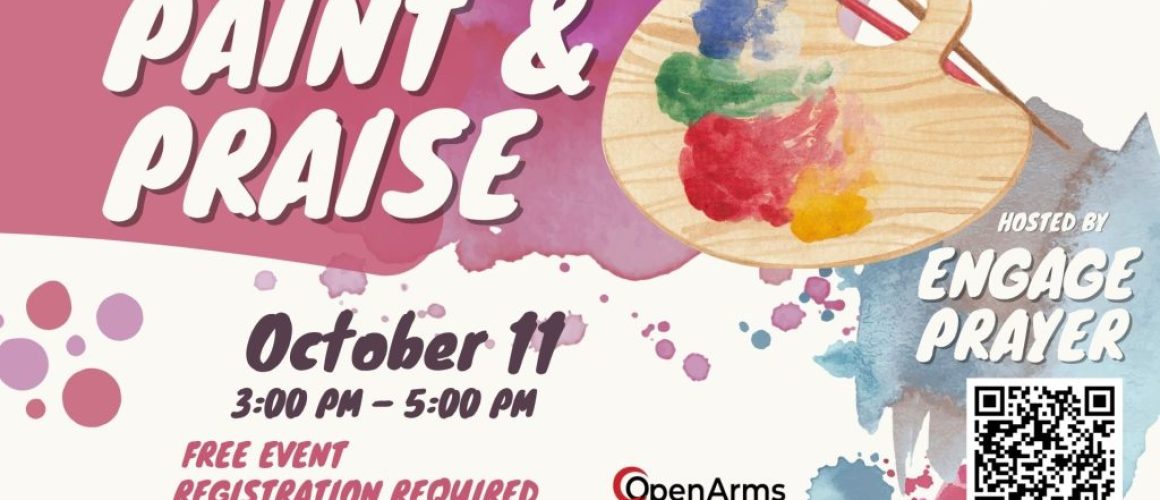
You’re invited to a unique fall event at Open Arms Community Church in Bradford, PA! On Saturday, October 11, from 3:00 to 5:00 PM, join us for Paint & Praise: Fall Edition, hosted by Engage Prayer.
🎨 What is Paint & Praise?
Paint & Praise is more than just a painting activity—it’s a chance to blend creativity, community, and worship. Together we’ll create a fall-themed painting, enjoy good company, and lift our hearts in praise. You don’t need to be an artist—this event is designed for everyone, no matter your skill level.
🍪 Homemade Treats from Harvest of Faith Microchurch
To make the afternoon even sweeter, Harvest of Faith Microchurch is preparing homemade treats for everyone to enjoy. It’s the perfect way to round out a cozy, faith-filled fall gathering.
🙌 Why Join Us?
Enjoy a fun, fall-themed painting project.
Connect with others in a warm, welcoming environment.
Savor homemade snacks.
Experience how art and worship can refresh your spirit.
📅 Event Details
Date: Saturday, October 11
Time: 3:00 – 5:00 PM
Location: Open Arms Community Church, Bradford, PA